Day 2
Wednesday, June 24, 2026
Cape Town — Sea Point, Table Mountain, and back on foot
▶ Watch the videos from this day
| Morning | The promenade. The sea, the sunglasses, a bird. |
|---|---|
| Then | Breakfast at BUTTER, across Main Road. |
| Midday | Uber to the lower cable station. We did not go up. |
| After | We walked home. All the way home. Not direct. 23,000 steps |
| Evening | Pizza at Posticino. |
She was right about the weather. We came out into a clear, cold, bright Cape Town morning — turned right out of the gate — and walked down to the sea.
The Promenade
The Sea Point promenade runs for miles along the Atlantic, a wide paved path between the grass and the rocks, and on a winter morning it belongs to runners, dog-walkers, and old men doing very slow exercises facing the water. The ocean here does not lap. It arrives. It hits the rocks and goes up, and the wind takes the top off it as a mist.
The sea-side wall is a kind of open-air gallery, hung with painted panels and posters that change through the year, so the walk doubles as an exhibition nobody planned to attend. And on a bigger swell the water does more than mist you: it comes clean over the rocks and washes across the path, and you learn to watch the sets and time your run past the wet stretches.
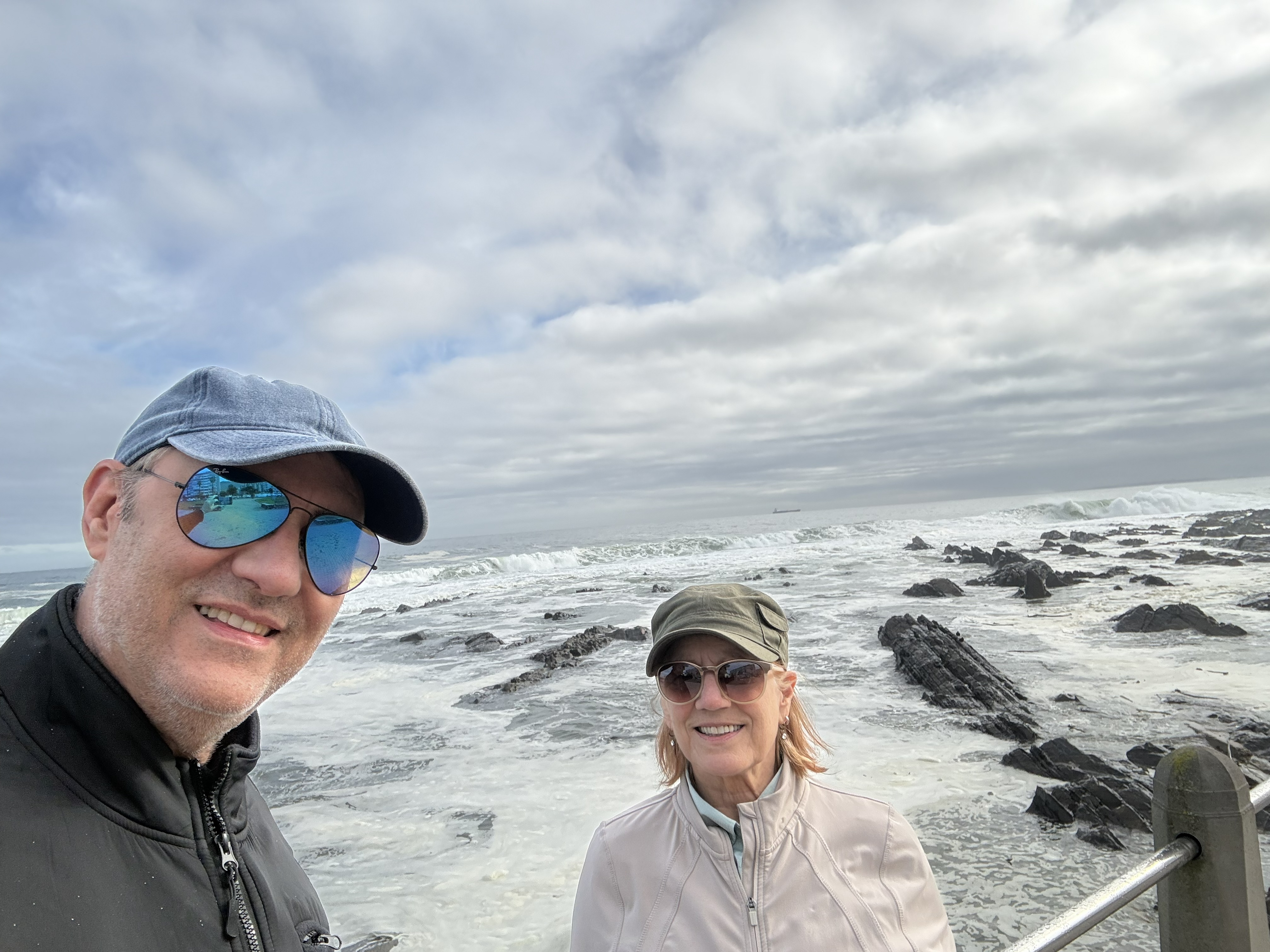
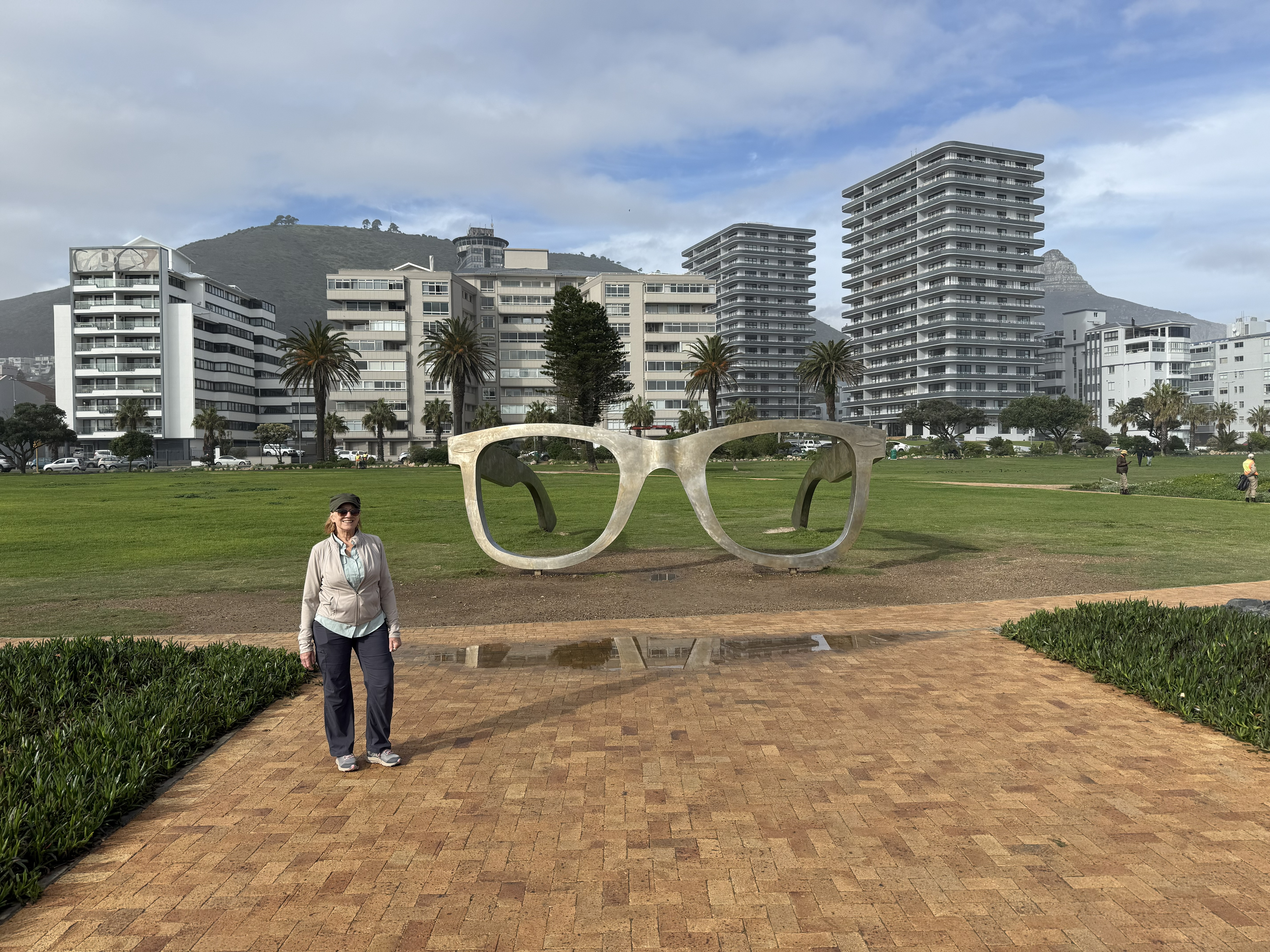
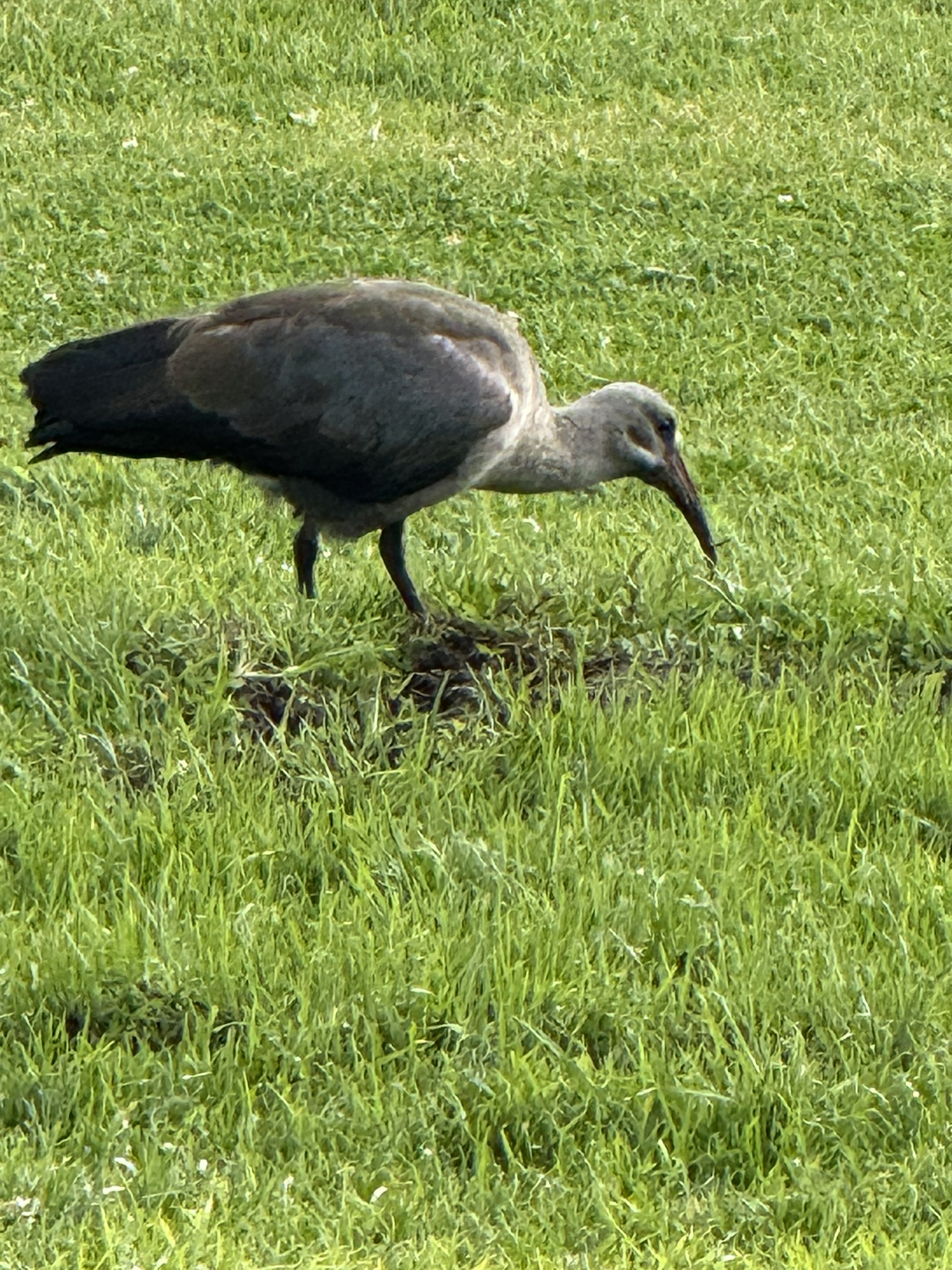
The bird is a hadeda ibis, and it is the most South African thing in this book. They are everywhere, they walk around on lawns with the confidence of a bird that knows nobody is going to bother it, and they make a noise at dawn like a rusty gate being murdered. Every South African has an opinion about hadedas. None of the opinions are neutral.
And then there were the sunglasses.

Bonnie found the smaller marvel of the morning. Somewhere along the front at Mouille Point she stopped walking: something was hanging in the air in front of the purple flowers, held up by nothing, humming — and then it was gone, to the next bloom and the next. “A hummingbird,” she said. A tiny one, smaller than a bumblebee. She filmed it, and the film came out a blur.
Once the tour had started she showed the clip to Dylan, who looked hard at the little screen. Dylan is a birder, and he knows his birds the world over. Nothing that small, he said, flies anywhere as a hummingbird. So it was not a bird at all. It was an insect, he was sure of that, and he was right. So we took the smudgy film home and stopped it, frame by frame, until the thing finally held still. As best we could make out, it was the African hummingbird hawk-moth, Macroglossum trochilus. It drinks through a long curled tongue, it flies by day rather than at night, and at the tip of its body is a little fan of scales that flares exactly like a hummingbird's tail. Long before Bonnie, someone else stood watching one hang in the air and thought precisely what she thought — which is how a moth comes to be named after a bird it merely resembles. Name it the plain “hummingbird hawk-moth,” for that matter, and you have conjured the Eurasian species, which does not live here: the same mistake, twice.
Breakfast, Eventually
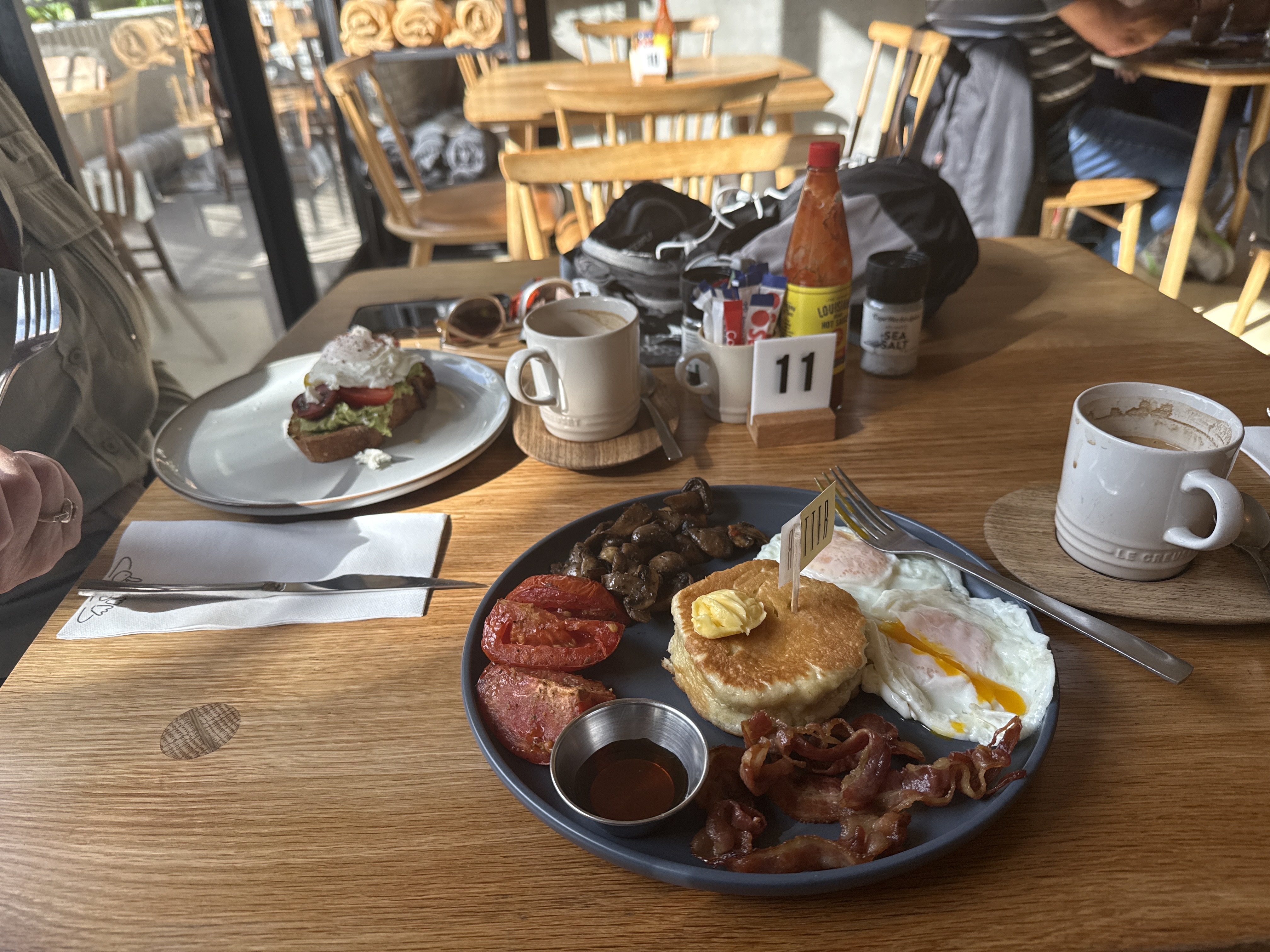
By the time we turned back inland we had walked ourselves hungry, and we knew where we were going. We had seen it on the list of places the guesthouse leaves out for you — a spot called BUTTER, just across Main Road — so we crossed over, went a little way left, and had breakfast.
BUTTER does one thing and does it seriously. A full plate: eggs, bacon, sausage, the works, and coffee that kept coming. We had eaten nothing but airline food for a day and a half. I do not think I have ever been happier to see a plate.
The Mountain We Did Not Climb
We took an Uber up to the lower cable station, which sits on the shoulder of Table Mountain with the whole city laid out beneath it, and then we decided not to go up. There were two reasons, and both of them were good ones. The first was arithmetic. Table Mountain was on the tour — the group would be going up during the Cape Town extension at the end, with EF. Paying to ride the cable car twice, three weeks apart, is a thing a person can do. It is not a thing a person should do. The second was that we were already looking at it. That shelf of rock where you queue for the car is itself most of the point: the city runs out beneath you from the mountain down to the harbor and the bay, Robben Island sits flat and pale in the haze, and the whole shape of the place — how it is wedged between the rock and the water — is right there, entire, for free. Going higher would mostly have made the same thing smaller.
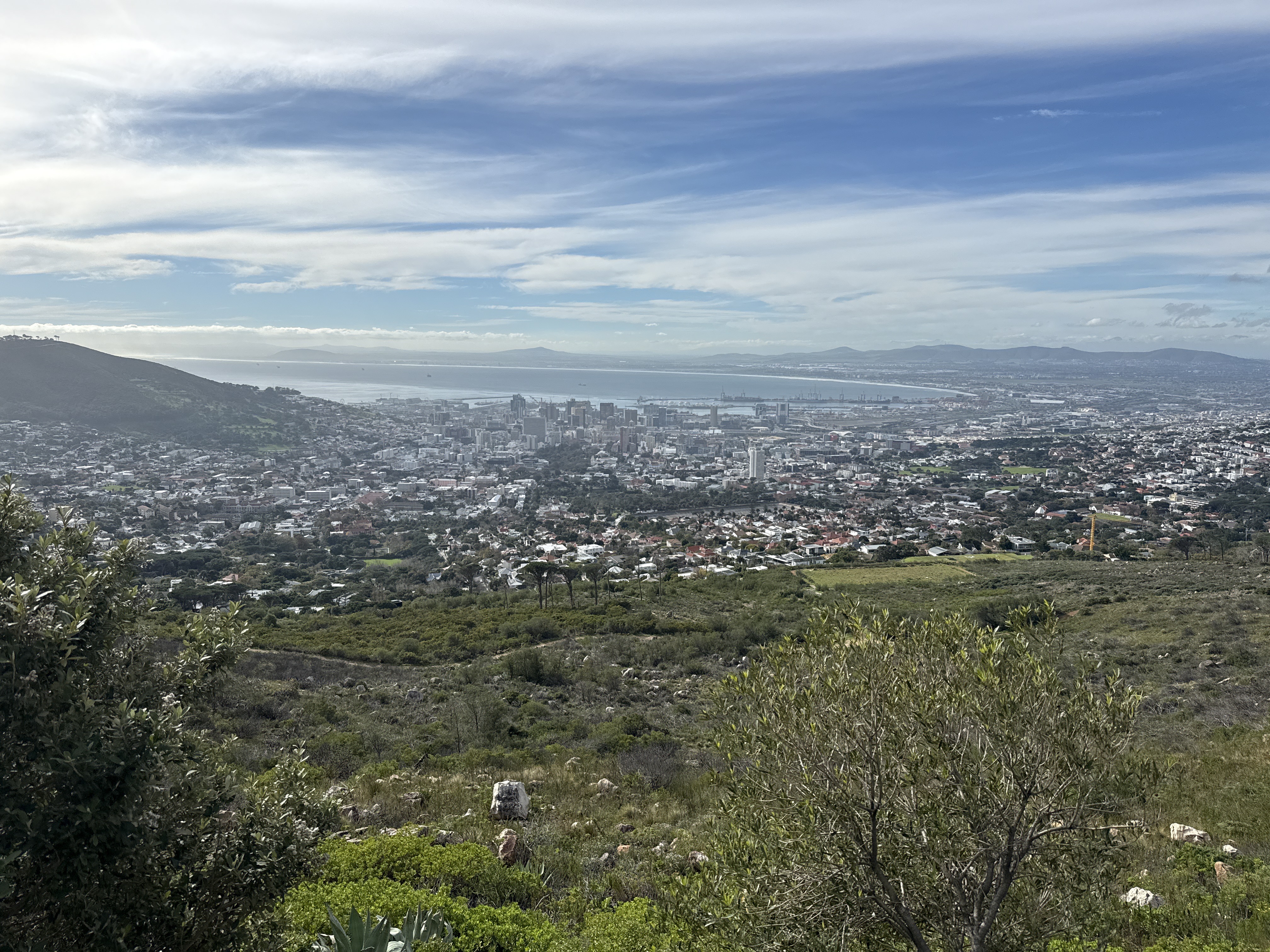
I thought I had taken more photographs up there than I actually had. There are a few, and they are all more or less this, and one view of a city is enough. And we did go up, in the end — weeks later, with the group, with Dylan telling us what we were looking at. But that comes much later in this book, and by then we had been to Botswana, and the mountain meant something different.
Twenty-three Thousand Steps
Then we decided to walk back to the hotel.
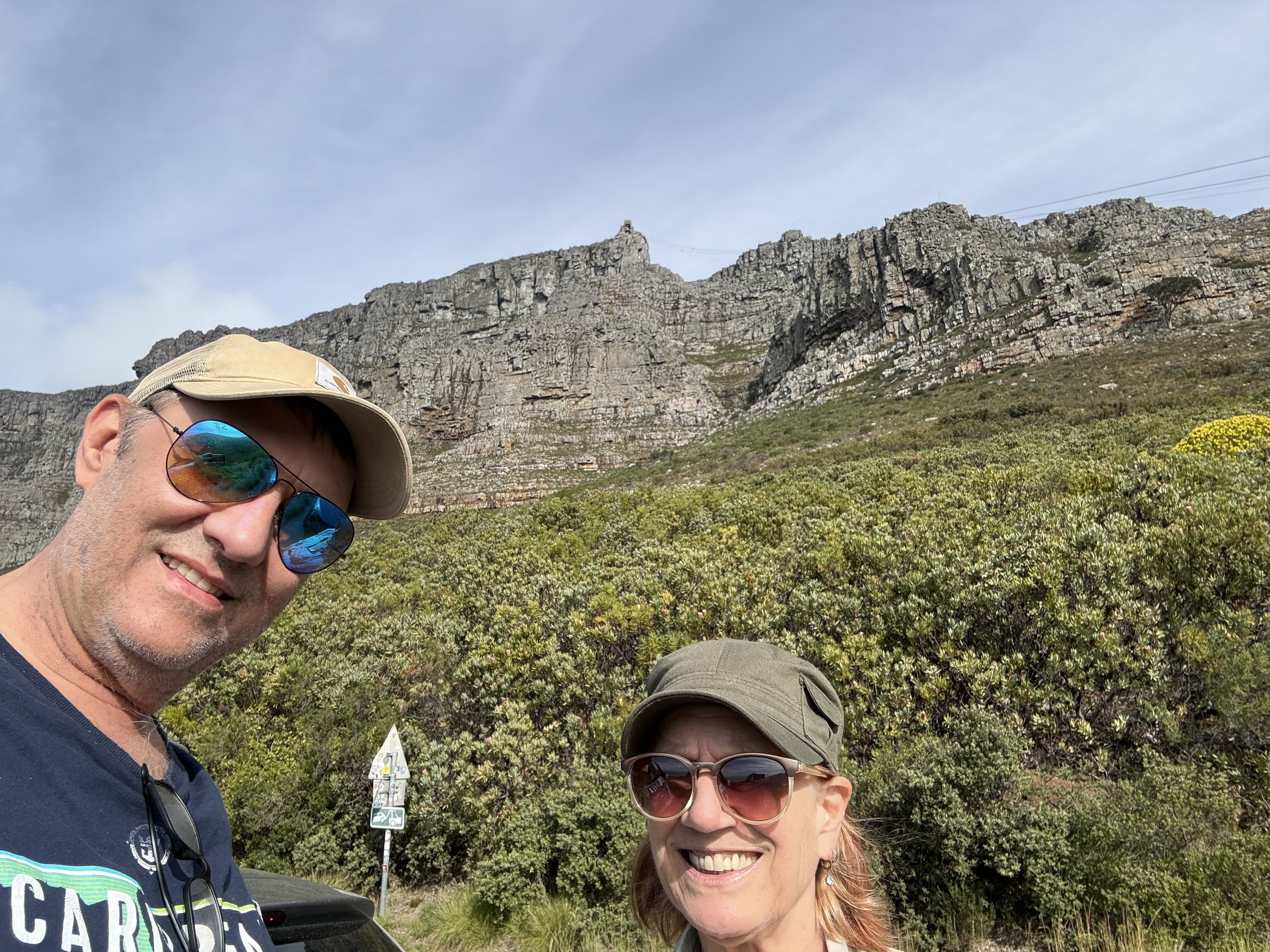
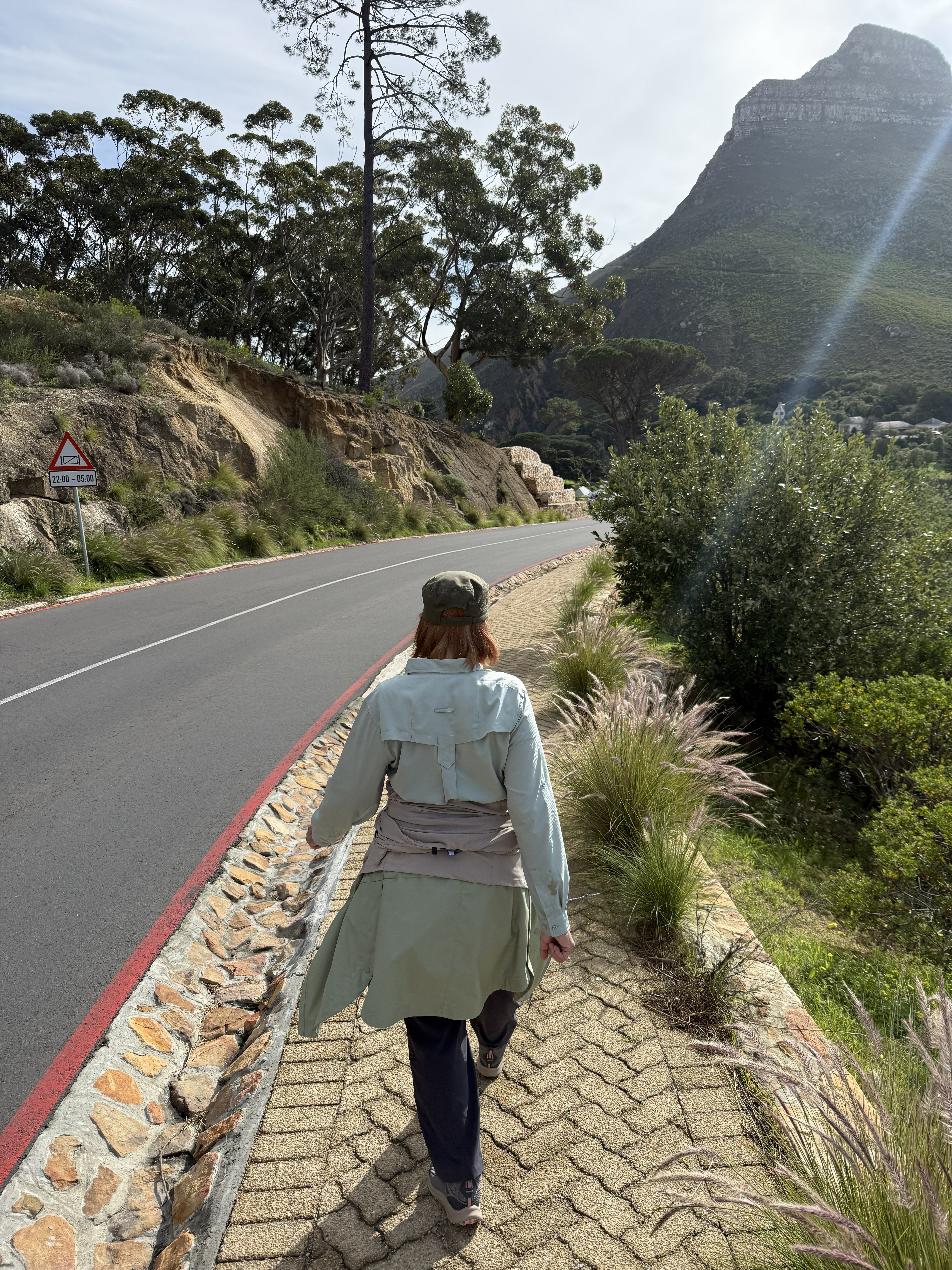
It is worth saying plainly that we did not have to do this. There were Ubers. There is a whole city of Ubers. But it was a beautiful afternoon and the hotel was over there somewhere and we are the kind of people who say “how far can it be,” which is the last thing a lot of people ever say. The pull of the sea was strong. It is strong for both of us, and it was strongest for Bonnie, who thought we could just go down to the water and follow it around to our hotel. It is a beautiful theory, and on a coastline that runs in a straight line it would have worked perfectly. Cape Town's coastline does not run in a straight line. Cape Town sits on a peninsula, and a peninsula has water on more than one side of it, which means “toward the sea” is not a direction. It is several directions, and some of them are the wrong one. You can walk downhill to the water, arrive at the water, feel entirely vindicated by the water — and be further from your hotel than when you started, because that is a different piece of ocean than the piece your hotel is on. So the water kept being right there, downhill and visible and obviously correct, and the phone kept pulling us the other way: inland, around, along the shape of the land instead of the shape of the map in our heads. And the phone kept changing its mind about when we would get there. That is the part I remember most clearly. We set off, and the GPS gave us an arrival time. An hour later — having walked steadily, having complained very little — we checked again, and the arrival time had gotten later. Not by a minute. Meaningfully later. We had walked for an hour and the hotel had moved further away. It did that more than once. And I will be honest about where my head went: I stopped looking at the view. I stopped caring about the architecture, the gardens, the extremely nice houses. I cared about one number on a screen, and the only thing I wanted in the world was to watch it go down. Eventually it went down. Twenty-three thousand steps. Somewhere around ten miles. Certainly twice as far as it needed to be.
How far can it be?
Me, wrongly, at the top of a mountain
Here is the part that makes it a story, and it happens weeks from now. At the very end of the trip we came back to Cape Town with the group — nine of us by then — and as the van was driving into the city Dylan gave us the talk. Don't walk. Take an Uber, or take the van, but don't set off on foot, not here, not on your own. And I laughed. Barely. Under my breath, mostly to Bonnie, I said something like we already walked the whole city. Dylan heard me. He turned around and called me out, in front of everyone, and he was not unkind about it but he was not joking either. I could do whatever I liked after the tour ended. While I was in his care he was responsible for my safety, and for everyone else's, and that was not a thing he was going to negotiate on a moving vehicle. And here is the thing I did not say in the van, because I had not worked it out yet. We were not brave that Wednesday. We were oblivious. That is a different thing and it deserves a different word. At no point in ten miles did either of us feel a flicker of it — no watched feeling, no wrong street, no moment of let's-turn-around. Nothing. We walked through a city we did not know, in a country we had been in for one day, reading a phone, and the entire time we felt completely fine. Which is not evidence that we were fine. It is only evidence that we could not tell. That is what Dylan was actually saying. He had eight other people to bring home and no way of knowing what any of us would do with permission. And — he mentioned this himself, and it is the part that ends the argument — he lives here. He was not reciting a liability paragraph from a binder; he was telling us what he knew about the streets we were driving through, the way you would tell a visitor which neighborhood back home to skip after dark. A tourist who has walked somewhere once and come back unharmed has one data point. A man who lives there has all of them. Nothing happened to us. It really was one of the best afternoons of the trip. But I might not take that walk again without asking somebody first.
Pizza
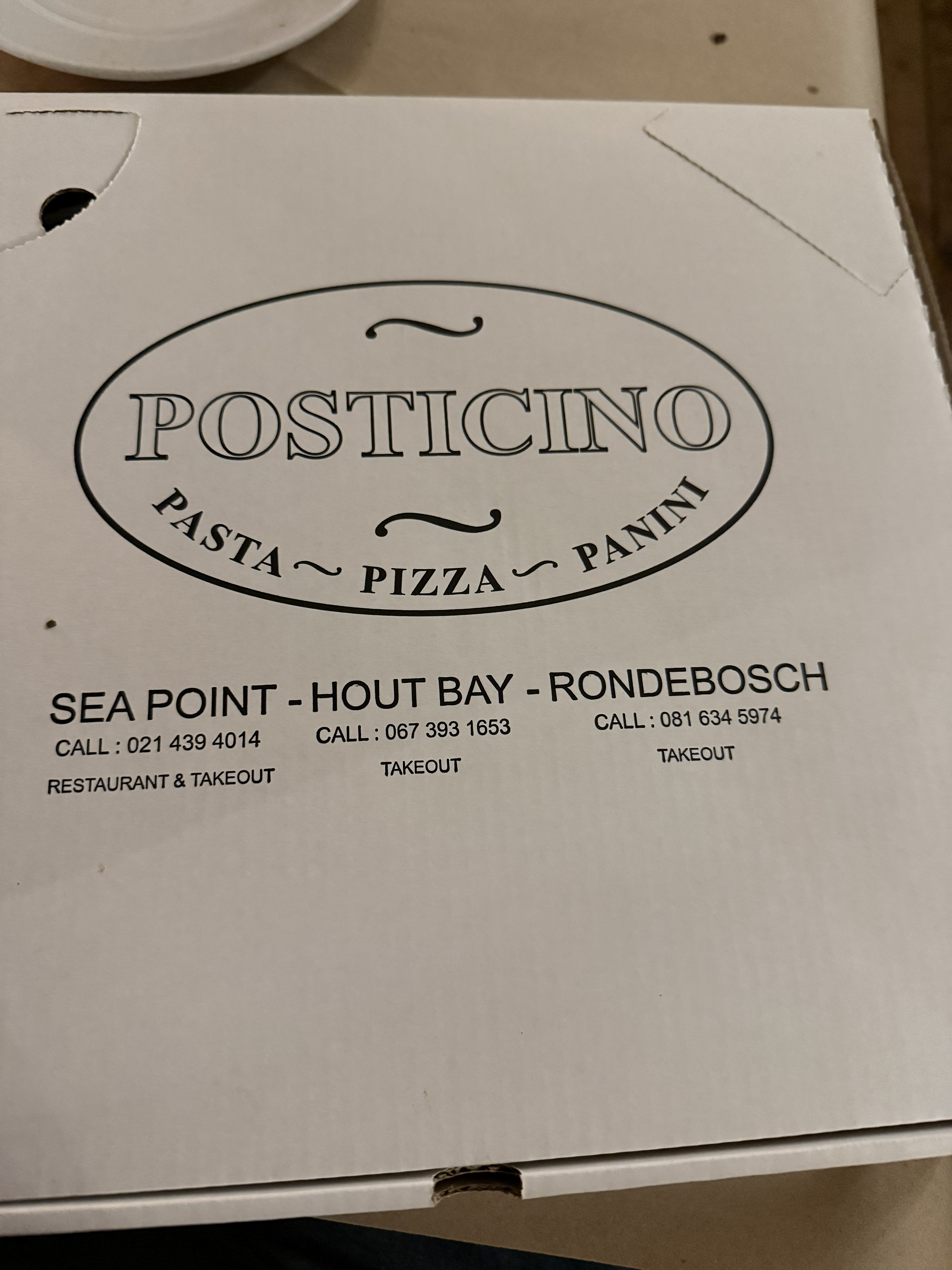
That evening we went out again — up Main Road this time, ninety meters or so, no crossing required — to Posticino, which is an Italian place at 323 Main Road that has been feeding Sea Point for a very long time. I had a pizza. After ten miles it tasted like the best pizza in Africa. It may have been. I was in no condition to judge. Bonnie had a Greek salad, I think. I would not swear to the salad. I would swear to the way she looked at the pizza.