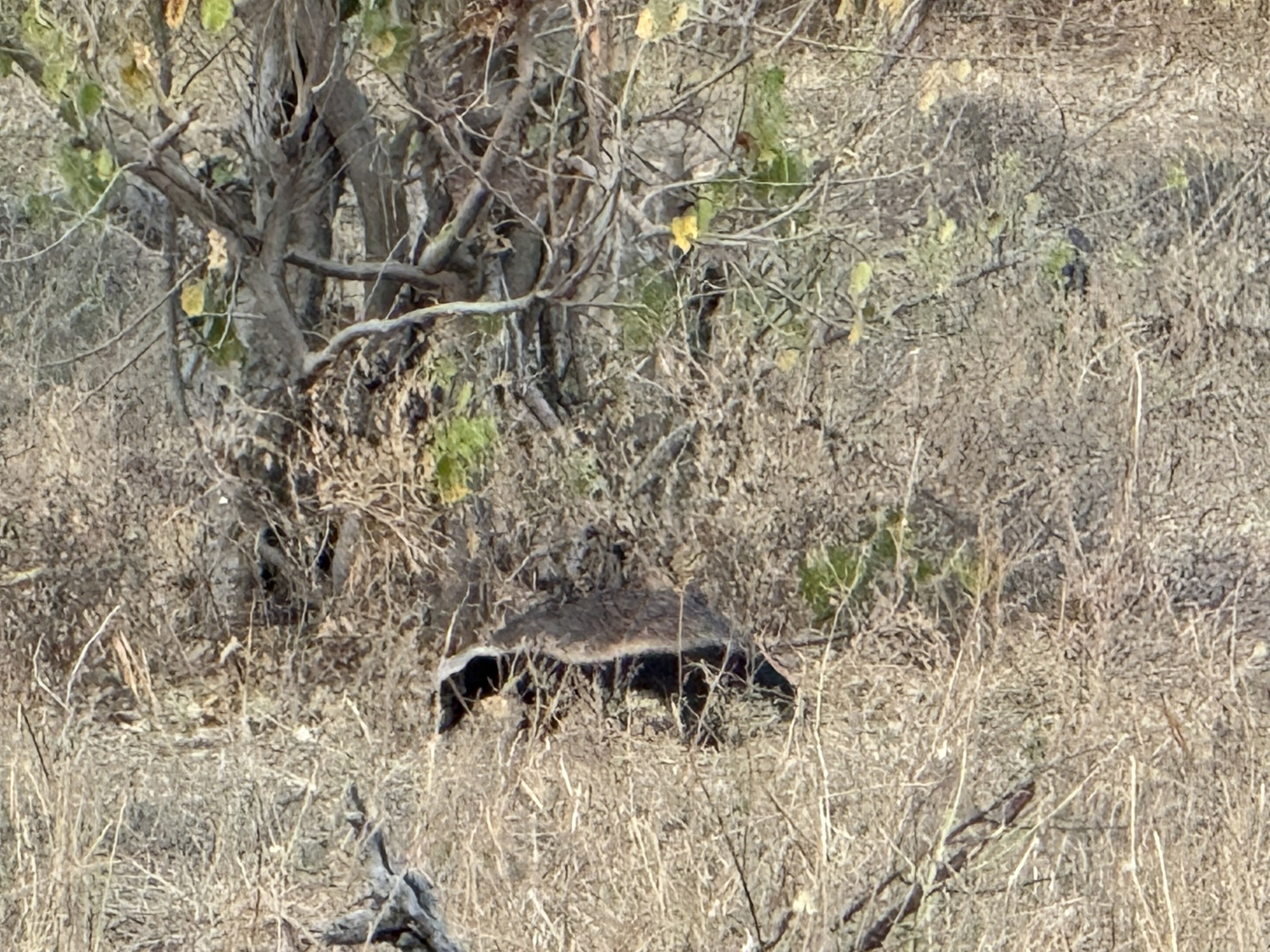
One last Chobe morning. A honey badger (Bonnie's).
Morning
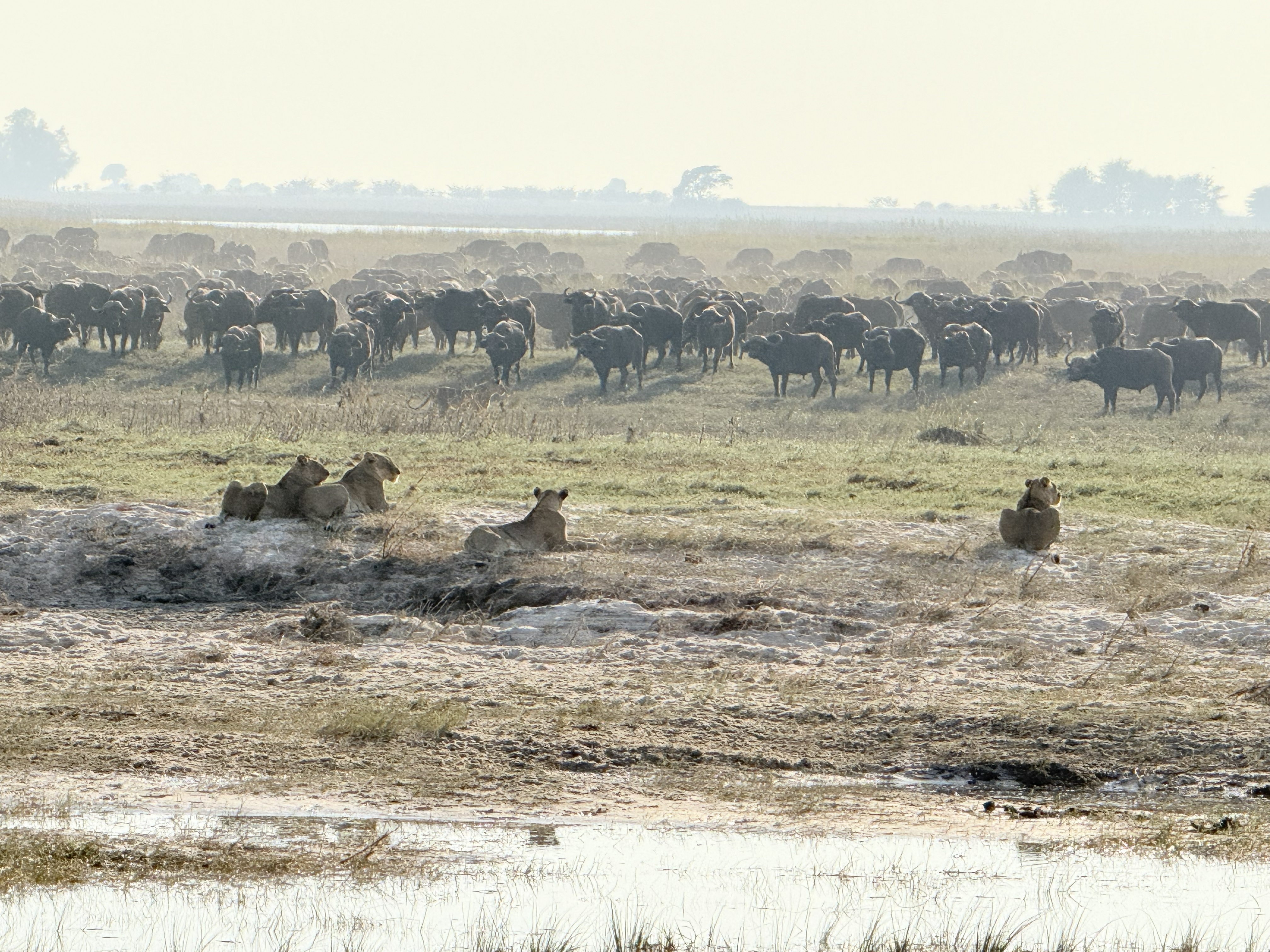
A lion pride and a buffalo herd, fought to a draw.
Midday
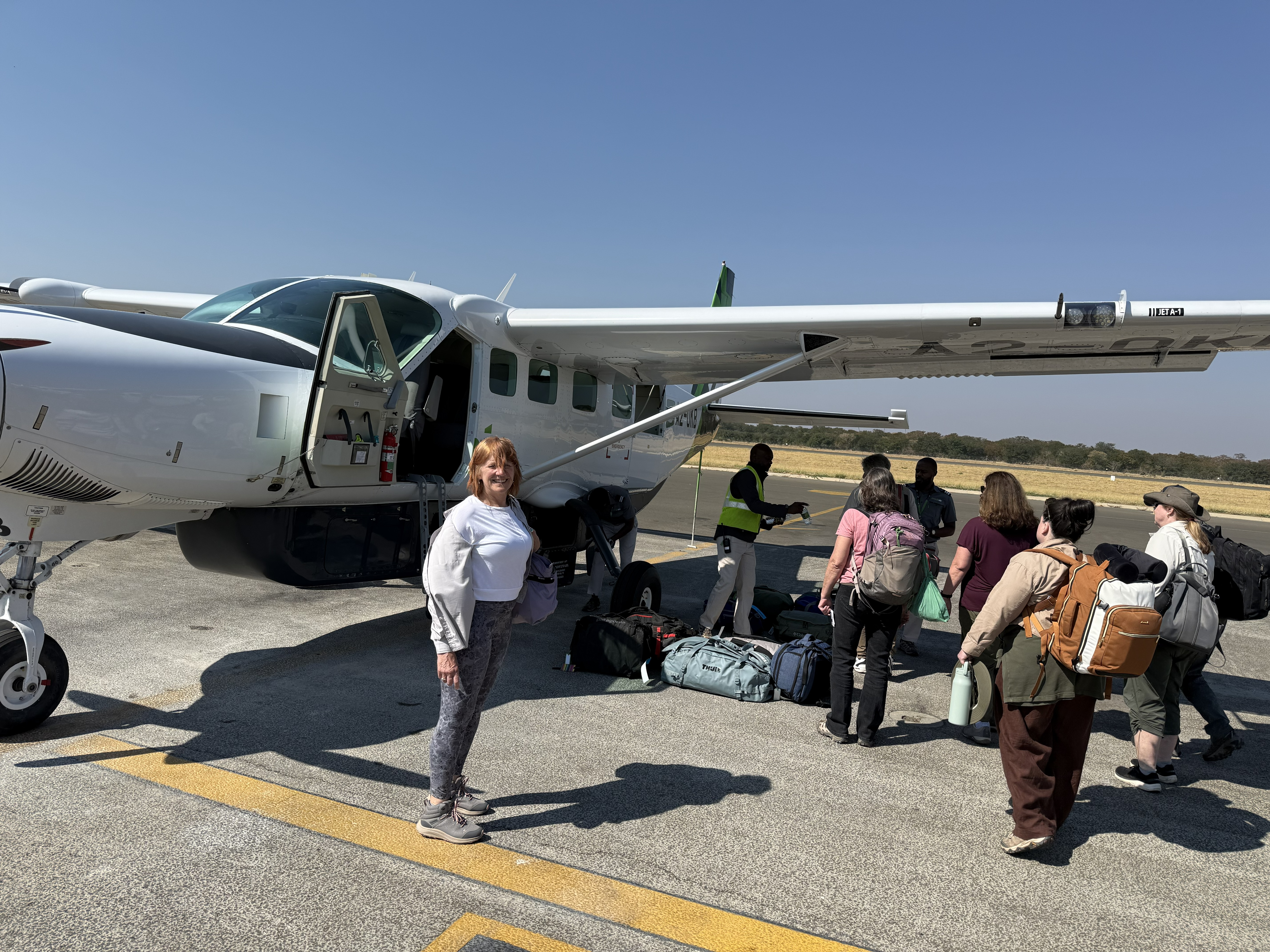
A small plane into the Okavango Delta.
Afternoon
The painted dogs.
Evening
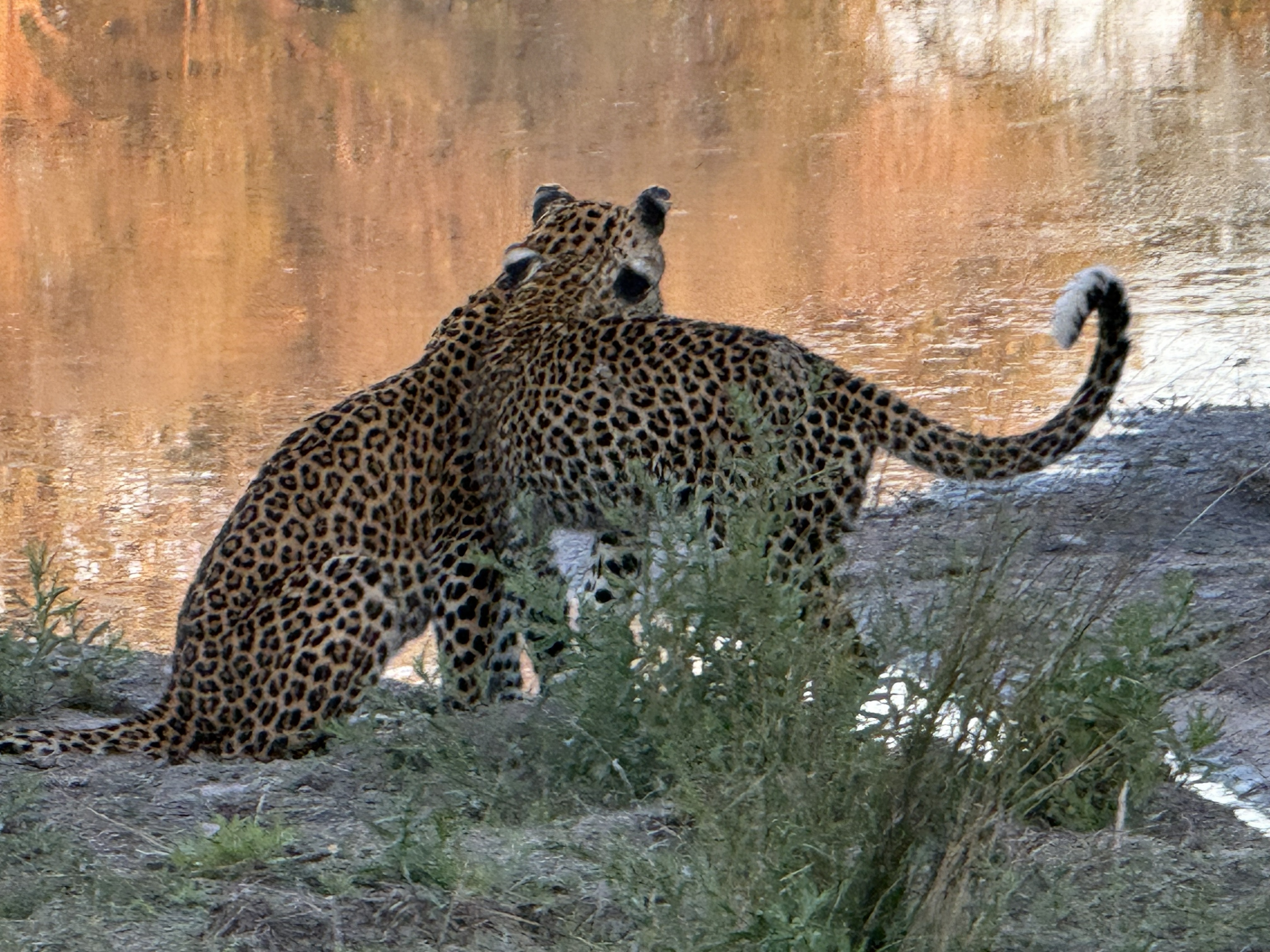
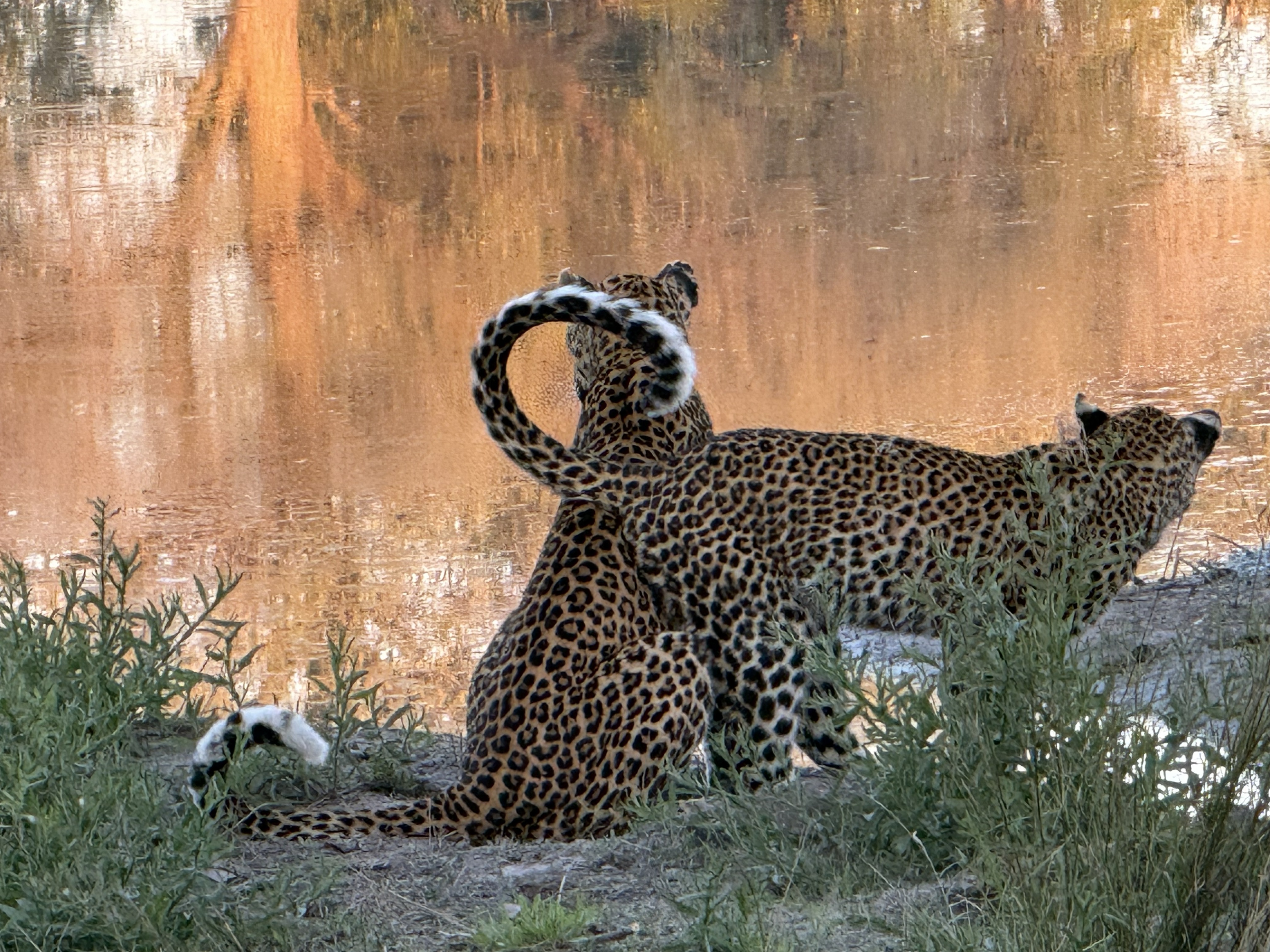
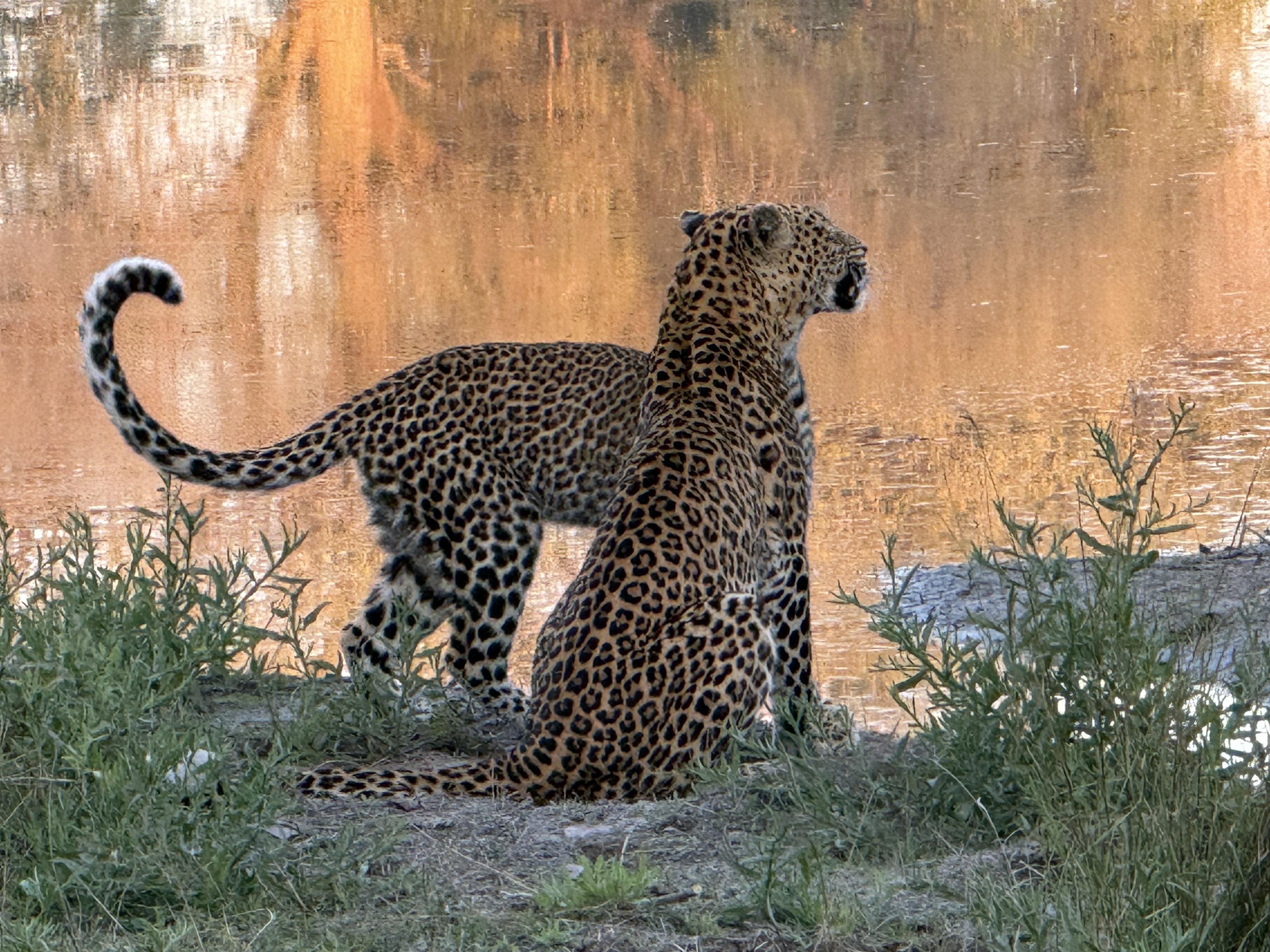
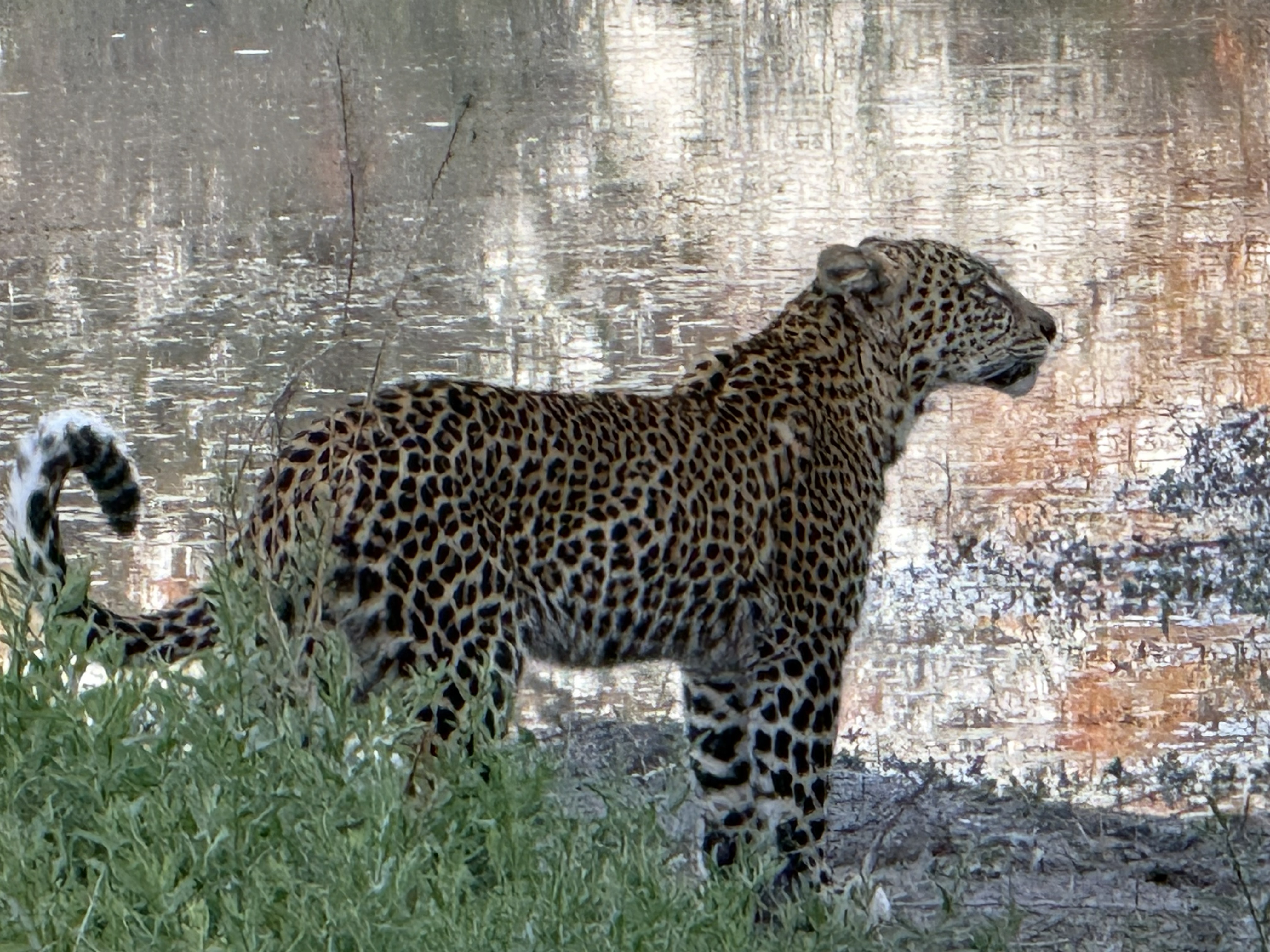
The leopards — a mother and her cub, at the water.
Every safari has a list of animals you are quietly desperate to see. The group's list had a leopard on it, the way every group's does. Mine had the painted dogs, and I had asked after them at every camp, of every guide, for eleven days, in the mildly embarrassing way of a man who knows he is asking for luck and asks anyway. The answer had always been the same patient no. Dylan had been keeping score, and he did something about it. Before we ever reached the Delta he had put it to the guides there as a job of work: these two animals were the gaps, and this was the last chance to fill them. Today the answer changed. But it changed slowly, and it began, as the best days do, with a morning that promised nothing at all.
One Last Chobe Morning
We went out early for the last time along the Chobe, into that thin grey light before the sun commits to anything.
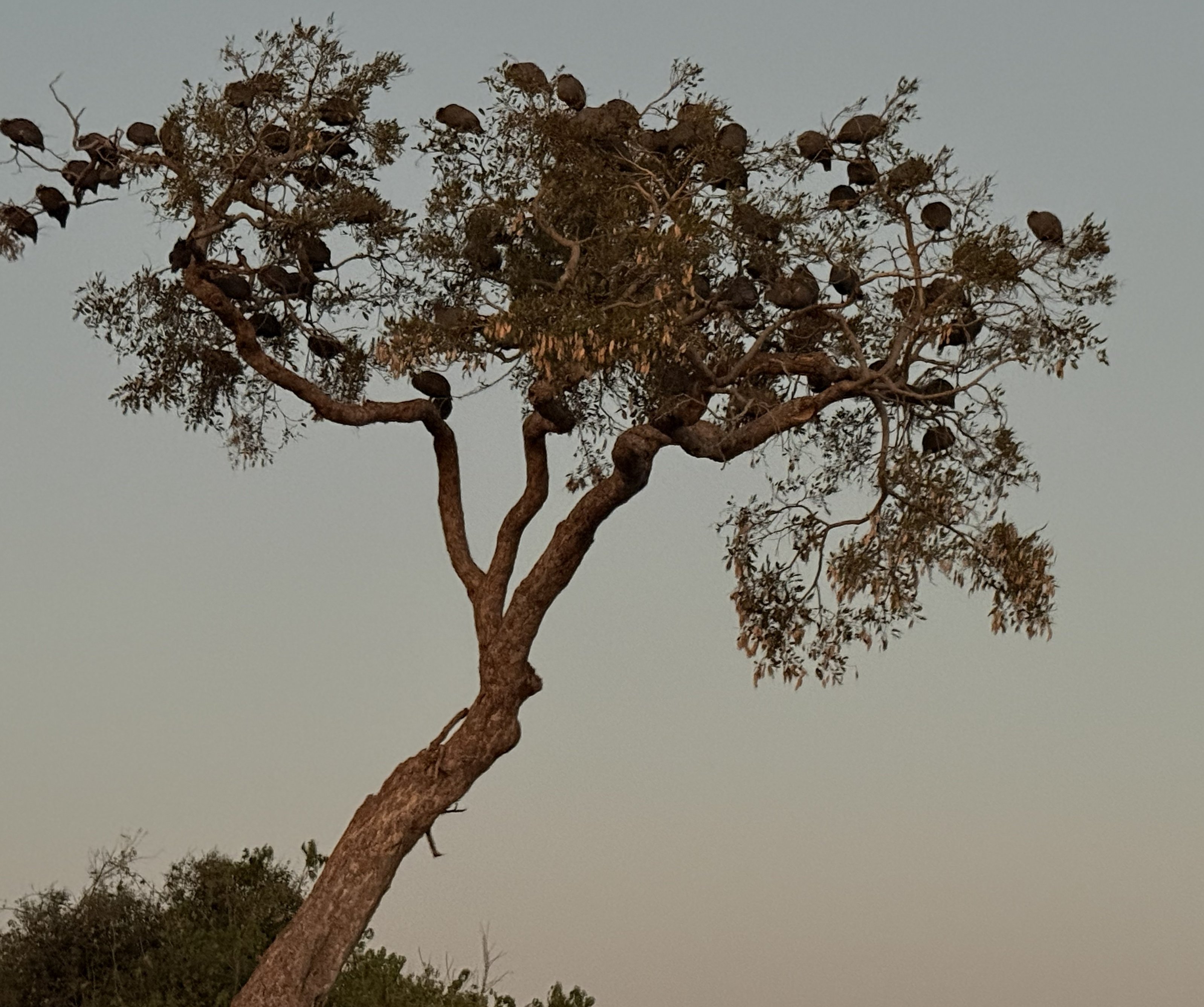
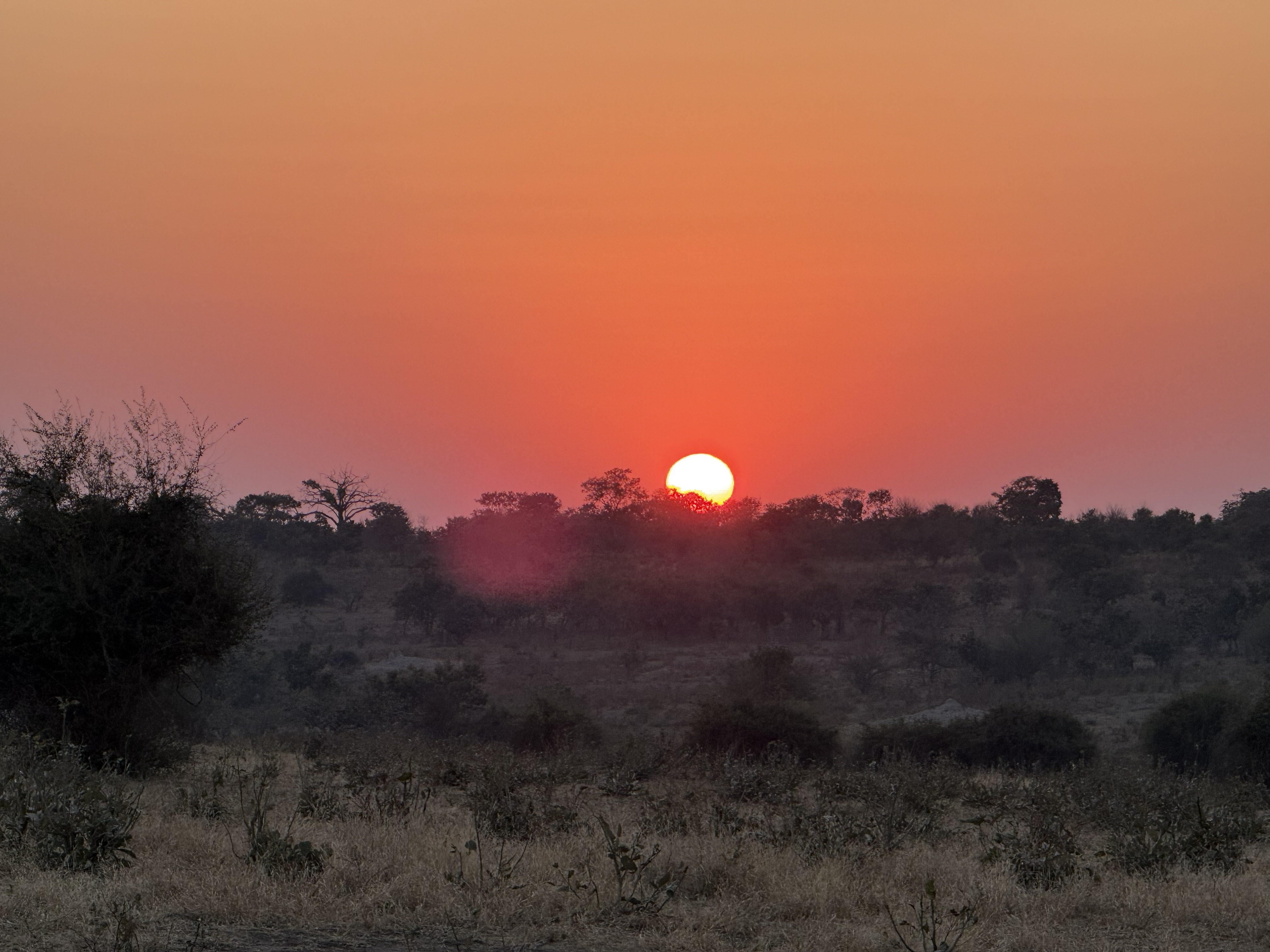
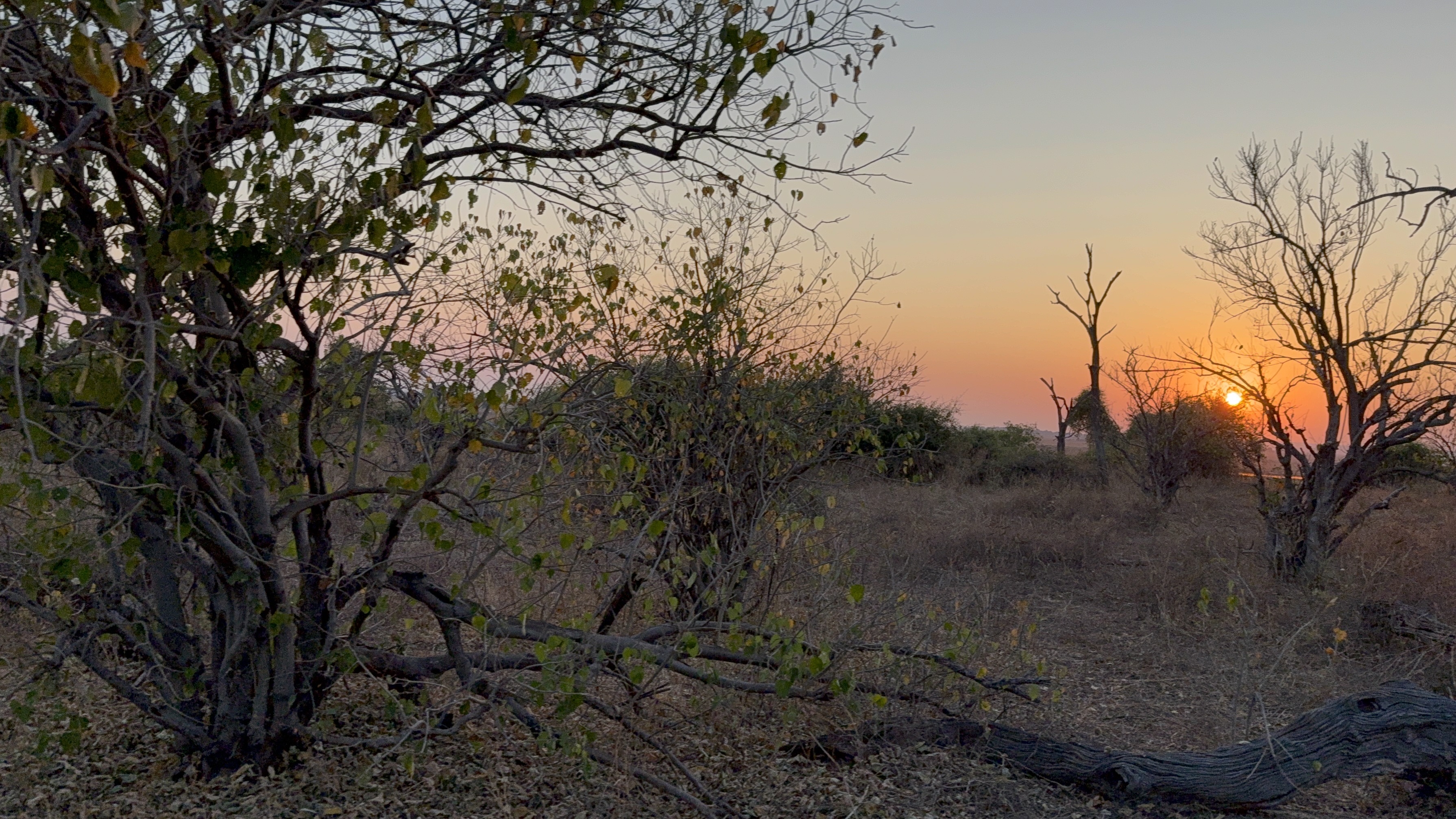
Guineafowl, roosting up a tree at dawn — which is where they spend the night, safely off the ground, before clattering down to spend the day being guineafowl.Sunrise over the bush, the river somewhere off to the side, the day still deciding what it would be.
And then Bonnie saw something. It was low and dark and humpbacked, bustling through the grass with tremendous purpose, and she asked — reasonably — what it was. The guides had not seen it, and were briefly, visibly put out: the spotting is their craft, and being scooped by a guest is a small professional wound. Then they got their binoculars on it, and forgave her at once. It was a honey badger.
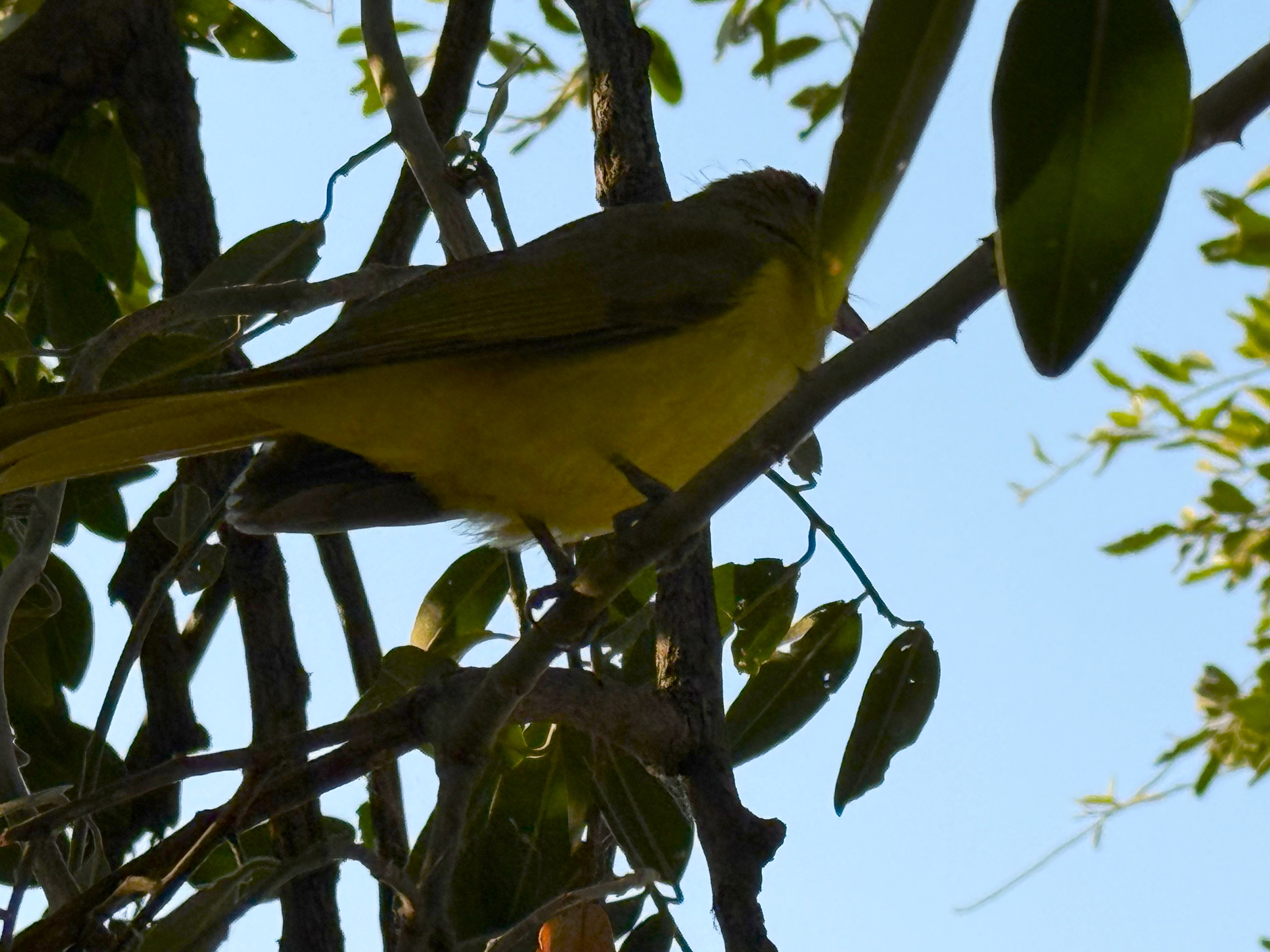
The honey badger — Bonnie's find. Famous for a fearlessness that borders on the unhinged (it has been known to see off lions), it is also nocturnal, wide-ranging, and genuinely difficult to catch in the open. The guides see them rarely. That a first-time visitor called it before they did was a small miracle, and to their great credit they said so.A yellow-bellied greenbul in the thicket nearby — lemon underneath, olive above, with the pale eye and the faintly scruffy look of the bulbul family. A skulker of dense riverine growth, more often heard than seen.
The Standoff
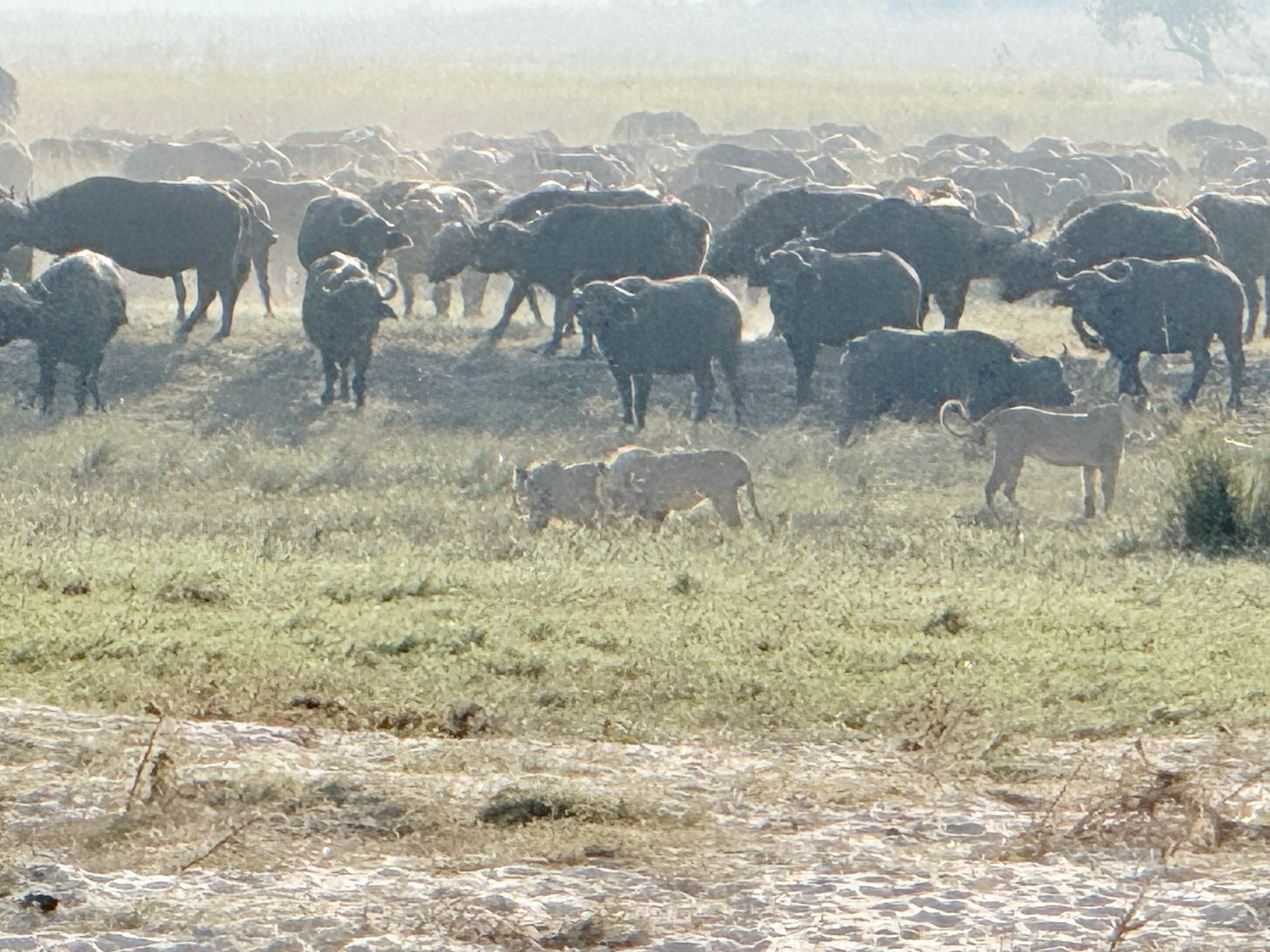
The morning's real drama, though, was a fight that never quite happened. We came on a lion pride at the water's edge, and in front of them — massed, black, and entirely unimpressed — a herd of Cape buffalo. What followed we watched for a full quarter of an hour: the lions would gather themselves and rush, the buffalo would wheel as one and present a wall of horns, and the lions would think better of it and fall back. Then again. And again. Dylan read it out for us like a man who had seen the play before. The buffalo, he said, were too organized — too many, too disciplined, too willing to close ranks — and the lions looked like juniors: young, and without the coordination to break a herd that simply would not panic. His verdict was that they would try all day and eat nothing.
The standoff. Lionesses in the foreground; behind them, the buffalo herd that would not be broken. The lions would charge, the buffalo would form up, the lions would retreat — over and over, for fifteen minutes.The herd, holding its nerve. A Cape buffalo herd that keeps its discipline is one of the few things on the plain a lion cannot solve alone — and these lions, Dylan reckoned, were not yet good enough.
I could have watched it all day, and very nearly argued for exactly that. But we had a plane to catch, and some dramas you have to leave unfinished.
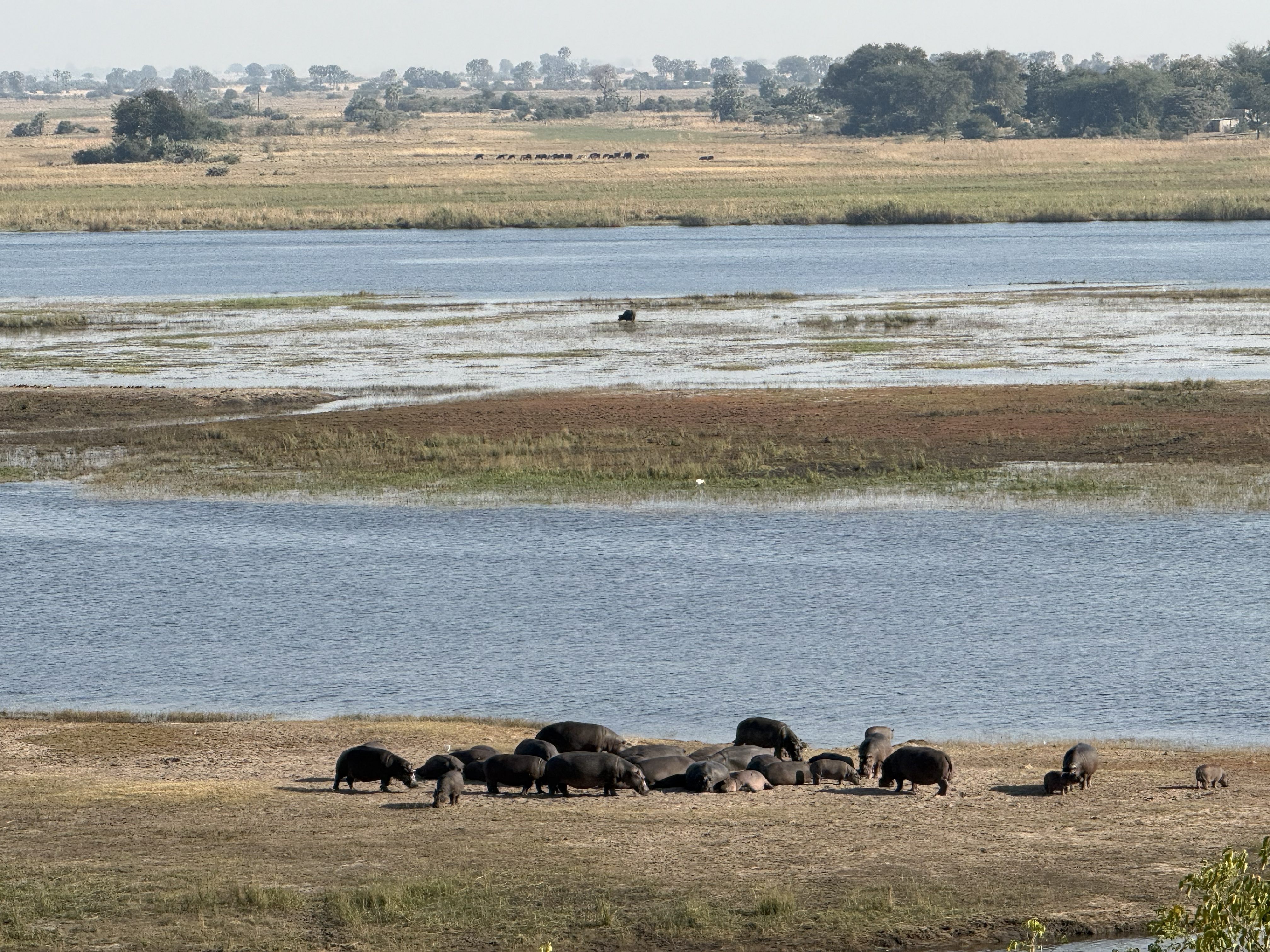
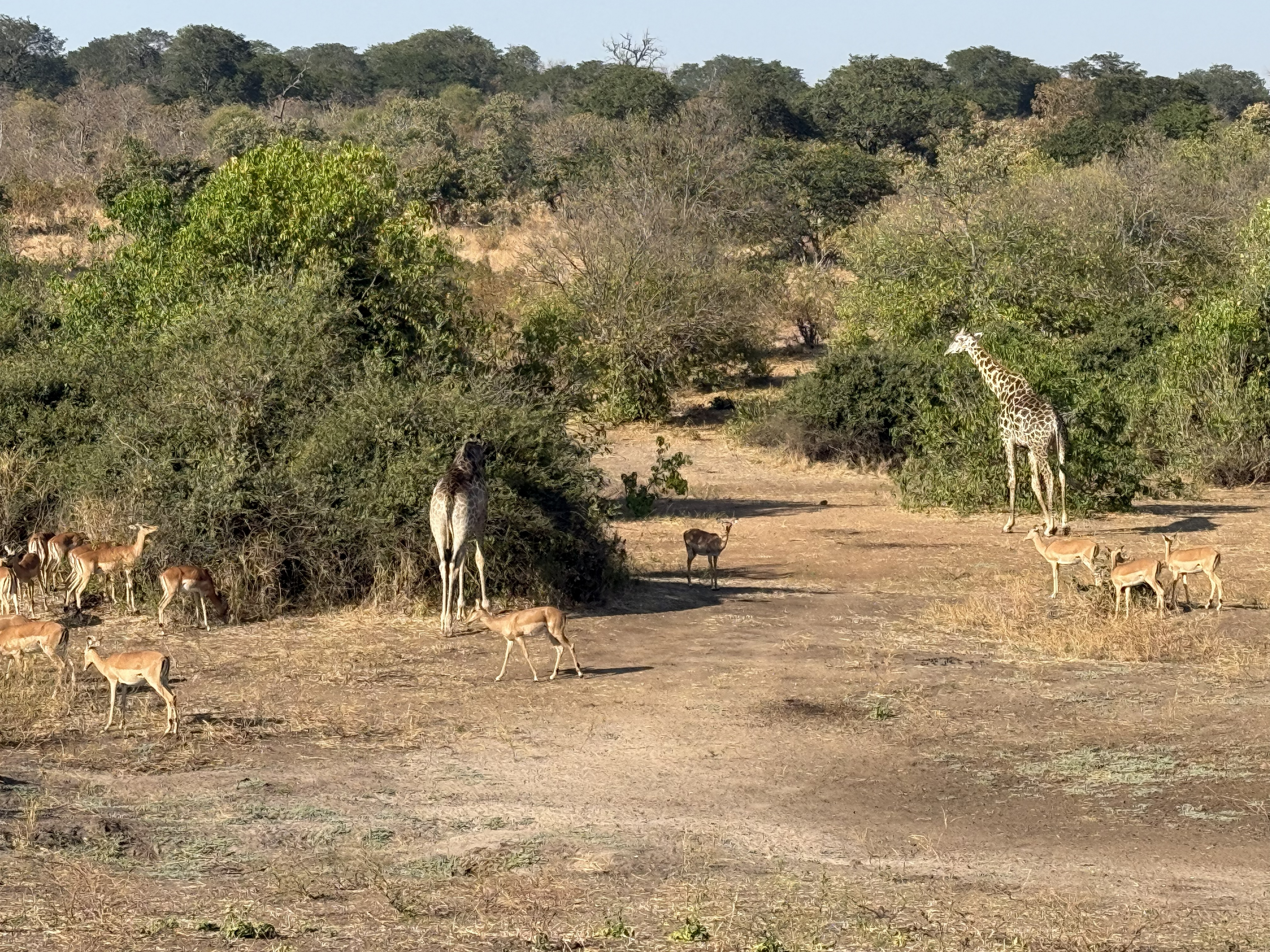
One last river scene on the way out: hippos hauled out on the near bank, a lone Cape buffalo off in the shallows, and — way across the water, almost too far to make out — cattle. Those, our guide told us, were cows belonging to Namibian farmers on the far side. You forget, in the middle of all this wilderness, that the opposite bank is another country entirely, with fence lines and livestock and someone's perfectly ordinary morning.One last gift from Chobe on the way out — the scene I kept calling our “Wild Kingdom” moment, after the old television show. Two giraffes and a scattered herd of impala sharing a single dry clearing, everyone browsing, nobody troubling anybody — so many animals in one frame you couldn't decide where to point the camera.
Wanted
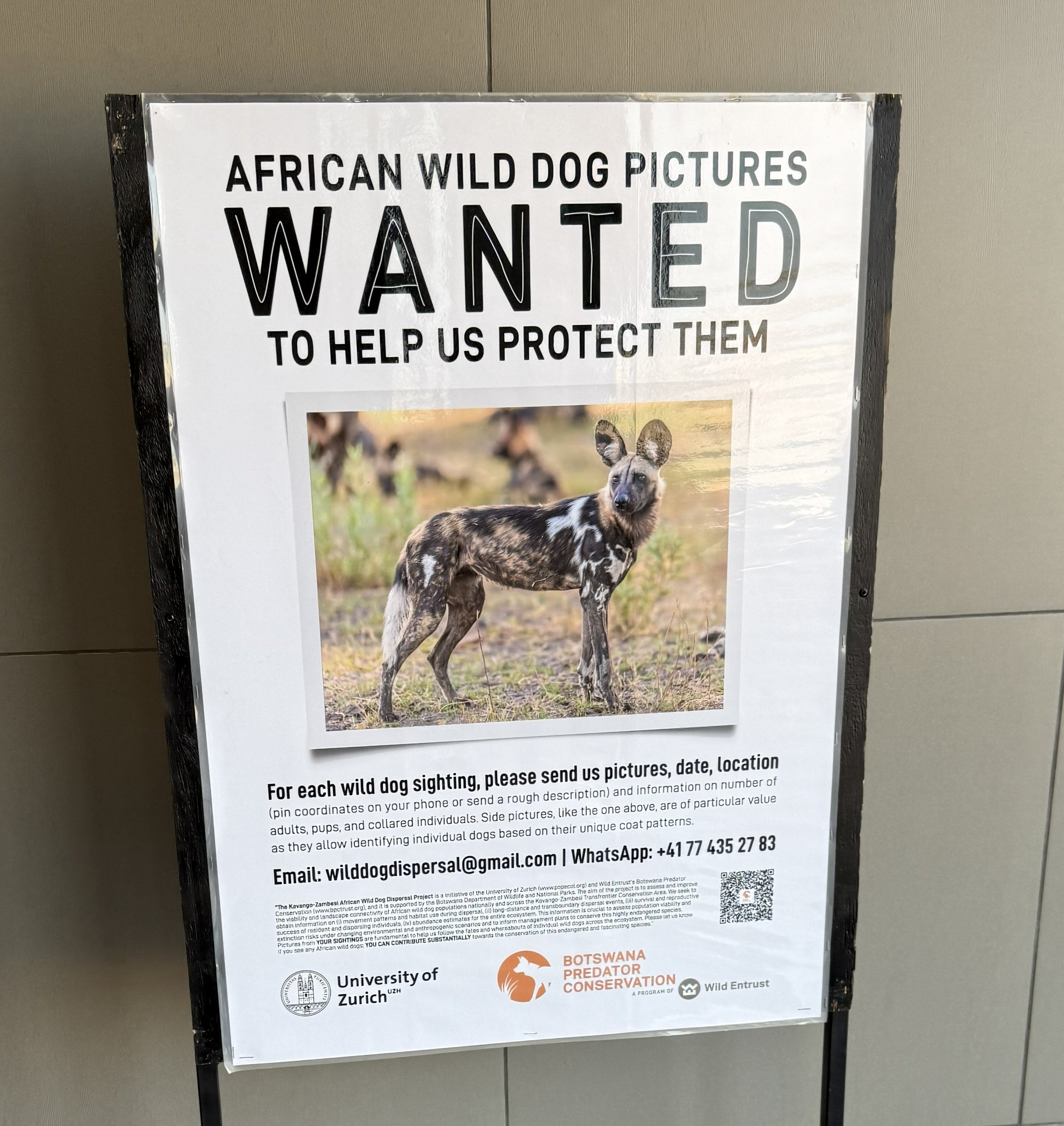
At the airstrip, waiting to fly out, I found this on the wall.
A conservation poster at the strip: “AFRICAN WILD DOG PICTURES WANTED.” I had, at this point, spent eleven days wanting exactly that and coming up empty. It felt less like a sign than a taunt.
I photographed it the way you photograph a thing you have given up on — ruefully, for the record. I did not yet know that the wall was, in effect, making me a promise.
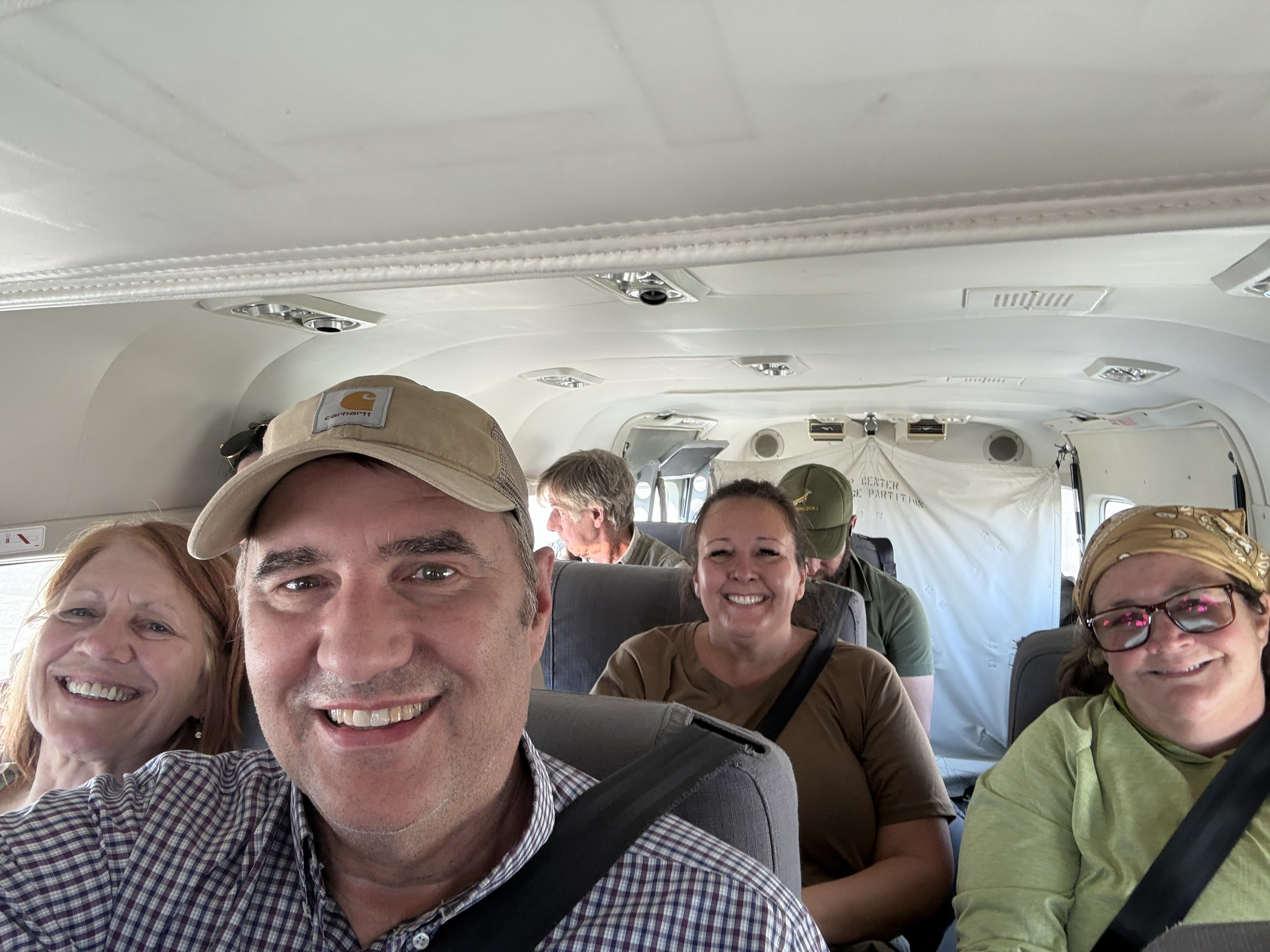
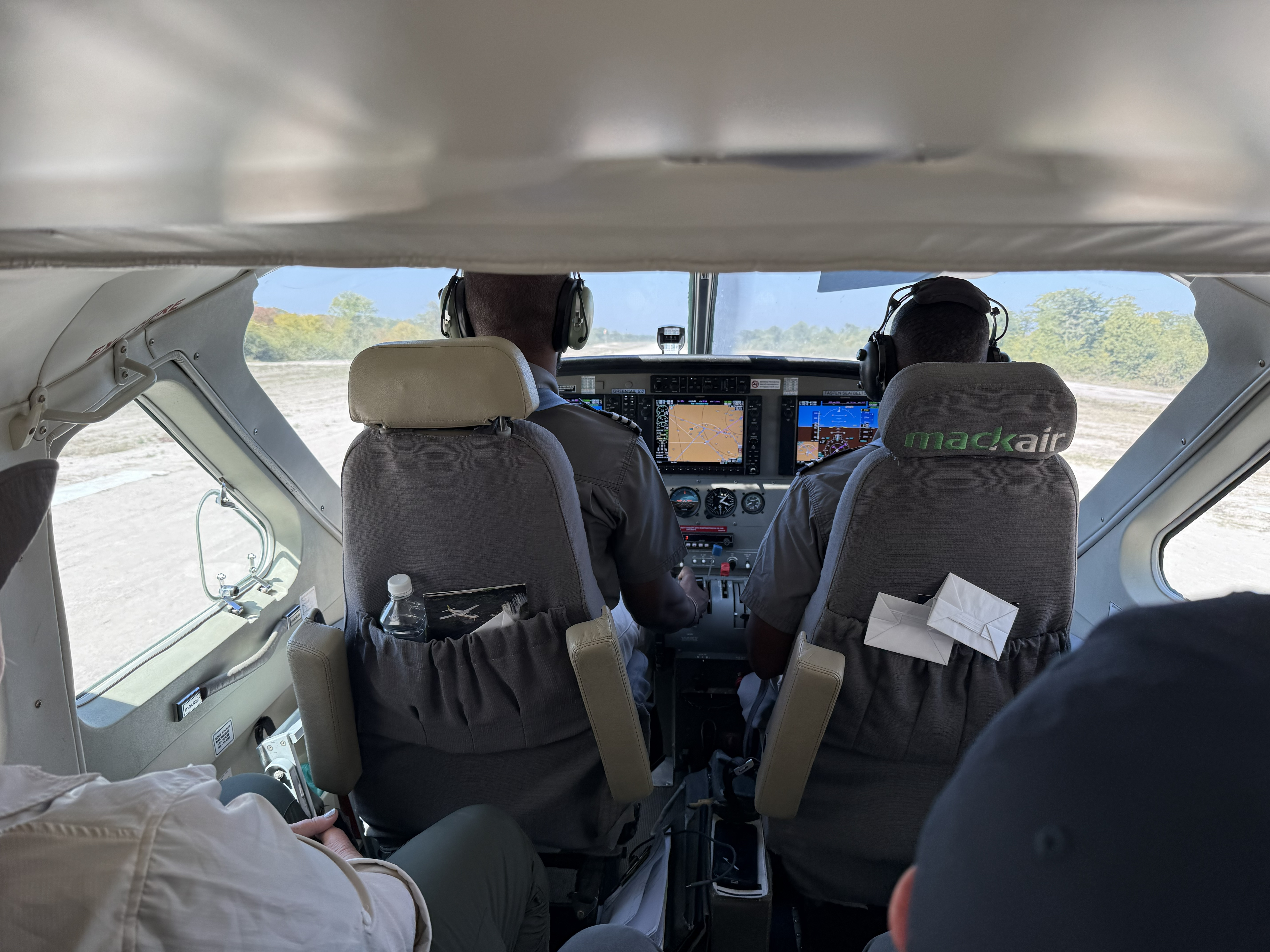
The plane on the strip, the group loading. From here on the roads mostly stop and the water begins.The cabin — knees together, cameras up, everybody grinning like children, which is the only correct response to a bush flight.Up front, the working end of it. There is no aisle, no announcement, no illusion of scale between you and the sky.
Then came the part of the day that every Delta trip involves and no photograph quite conveys: the small plane. You leave the tar and the crowds behind, climb into a single-engine Cessna with a dozen strangers and their duffel bags, and lift off over a landscape that goes, within minutes, from ordinary to impossible — channels and islands and floodwater scattered across the Kalahari like spilled mercury.
The Delta, and Two New Men
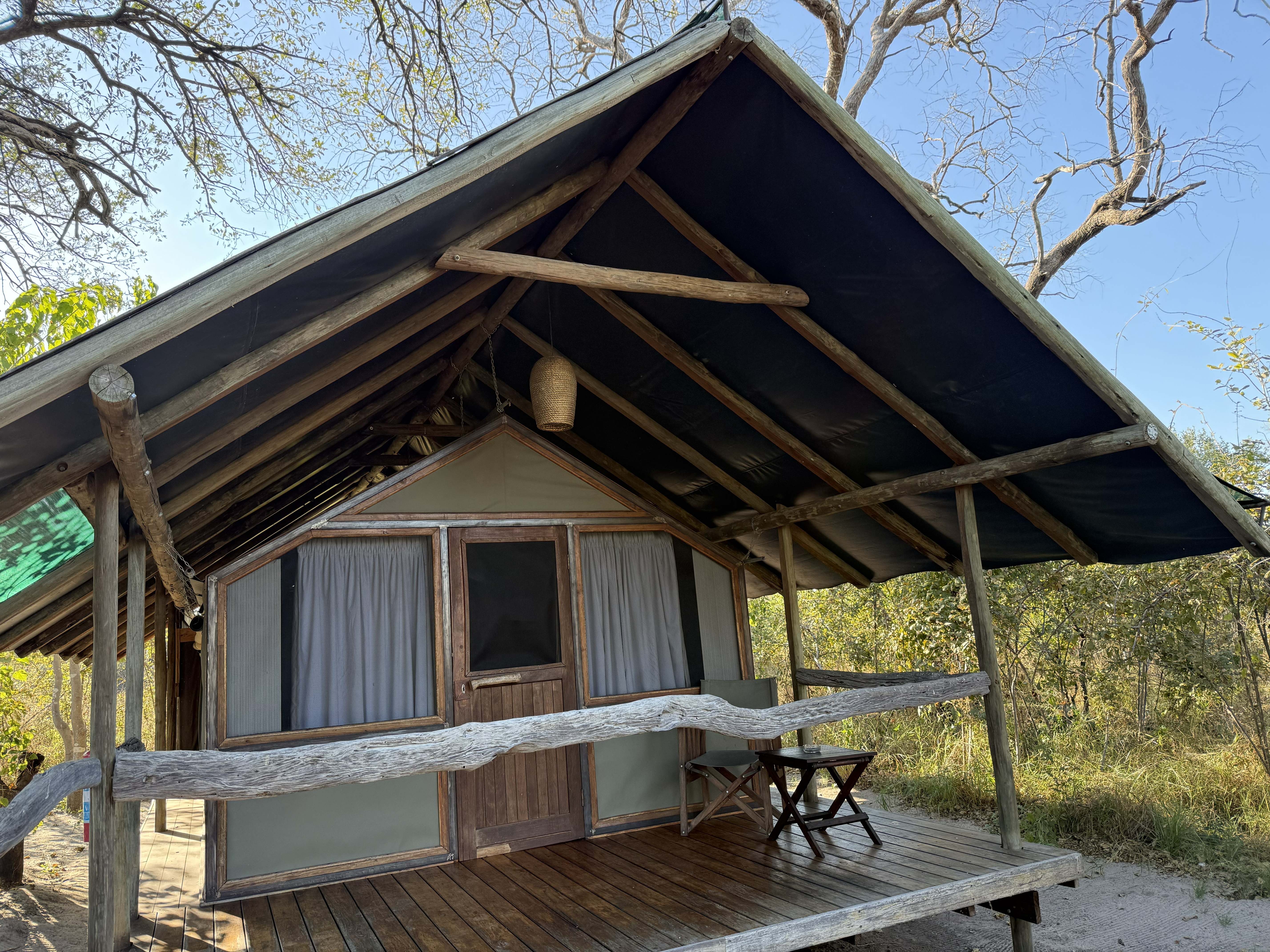
We came down on a strip cut into the bush — Khwai, in the eastern Okavango — and were met by our Delta guides: Obert, who would have our vehicle, and Watch, who would run the other. New country, new men, and the same hopeful question from me before we had fully sat down. Obert introduced himself with a line he had clearly used before and clearly still enjoyed: “Obert — Robert, without the R.” It stuck, and so did he. Over the next days he would prove uncanny at finding whatever we asked for, the animals seeming to arrive more or less on order. Later in the week, when he momentarily forgot my name, I got to hand the joke back: “It's Obert,” I told him, “with an R in front.” Our home here was Saguni Safari Lodge, a scatter of canvas tents raised on wooden decks beneath the old riverine trees, on an island looking out over a lagoon. Saguni is the San name for this stretch of country, and it means — I am not making this up — “a place of abundant game and spectacular sights.” We were about to find out how well it had been named.
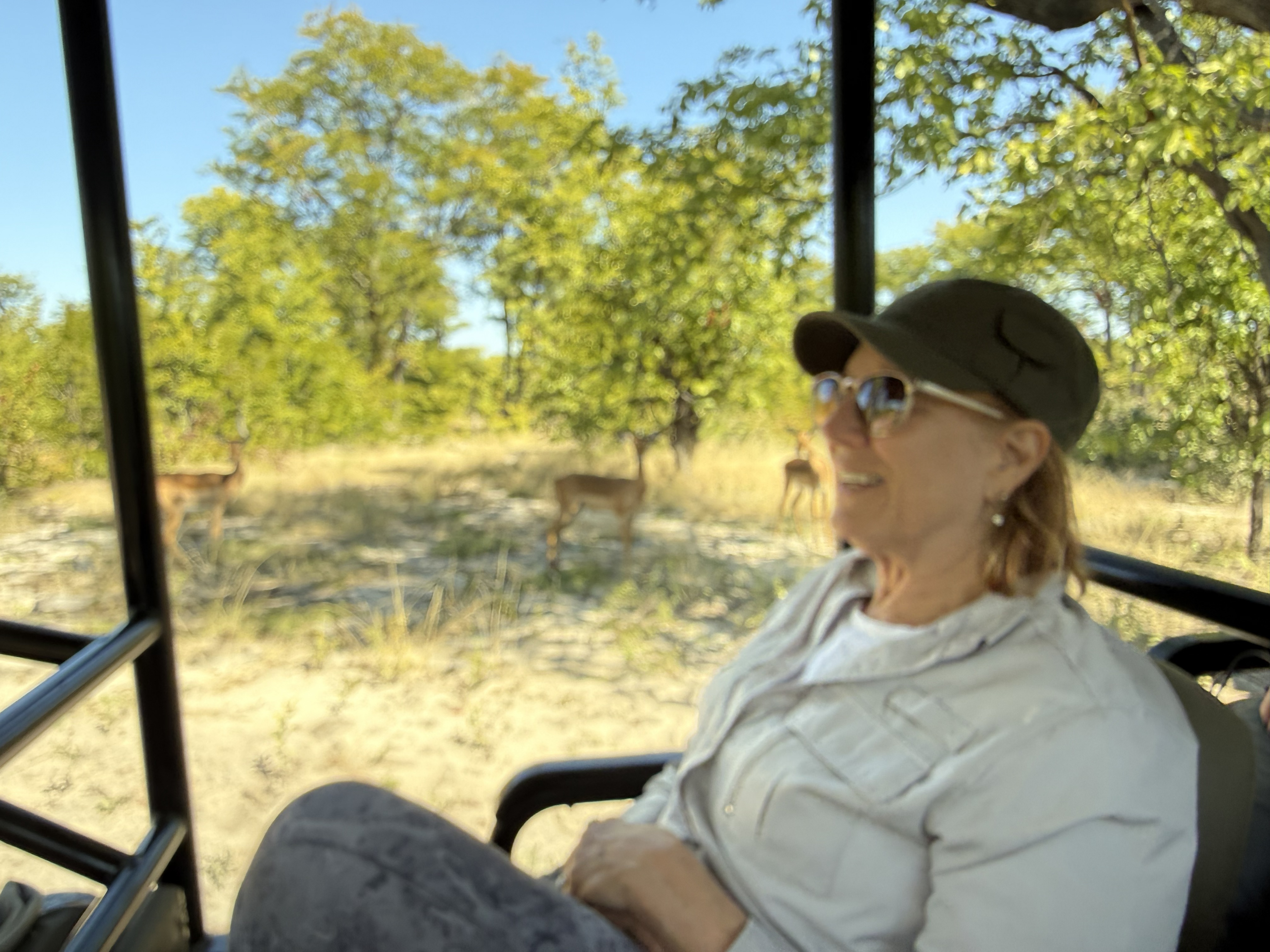
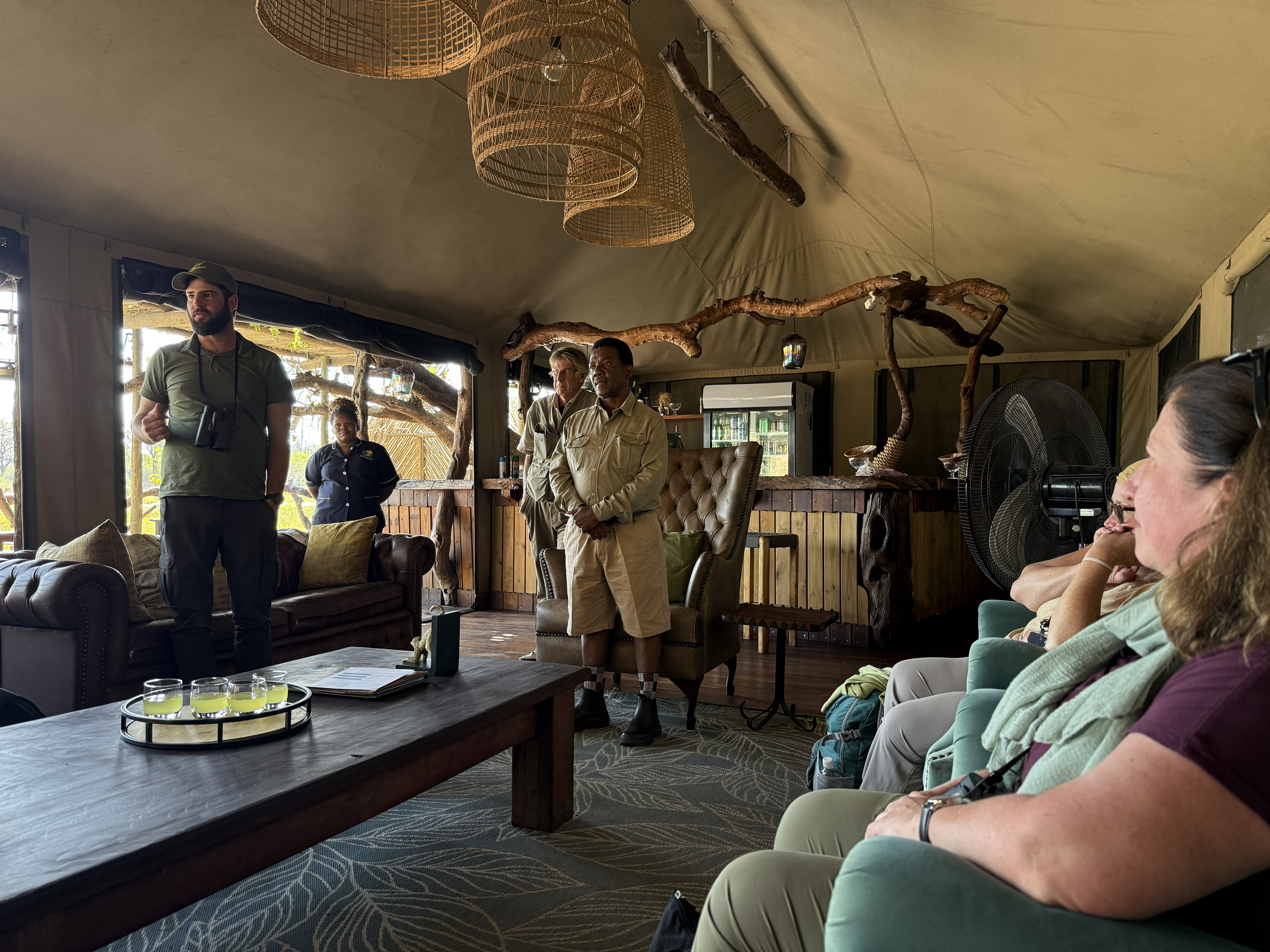
Bonnie on the first Delta drive — and the real story here is out the side of the truck, slightly out of focus: impala. By now we drove straight past them without turning our heads. Eleven days in, the most beautiful antelope in Africa had become the thing you no longer bother to photograph, and this frame is the proof — Bonnie in focus, the impala left to blur.The welcome briefing in the lounge tent: Dylan (green cap) and the Saguni staff walking us through the Okavango and, more to the point, the rules after dark. You do not wander here at night — a guard escorts you to your tent, and in the morning someone checks the path and the surrounding bush and knocks on your door before you are cleared to step out. The wild, quite literally, at arm's length.
Our tent — canvas and timber on a raised deck under the trees, a camp chair on the veranda. Glamping, in the honest sense of the word: the wild at arm's length, and a real bed to come home to.
The Dogs
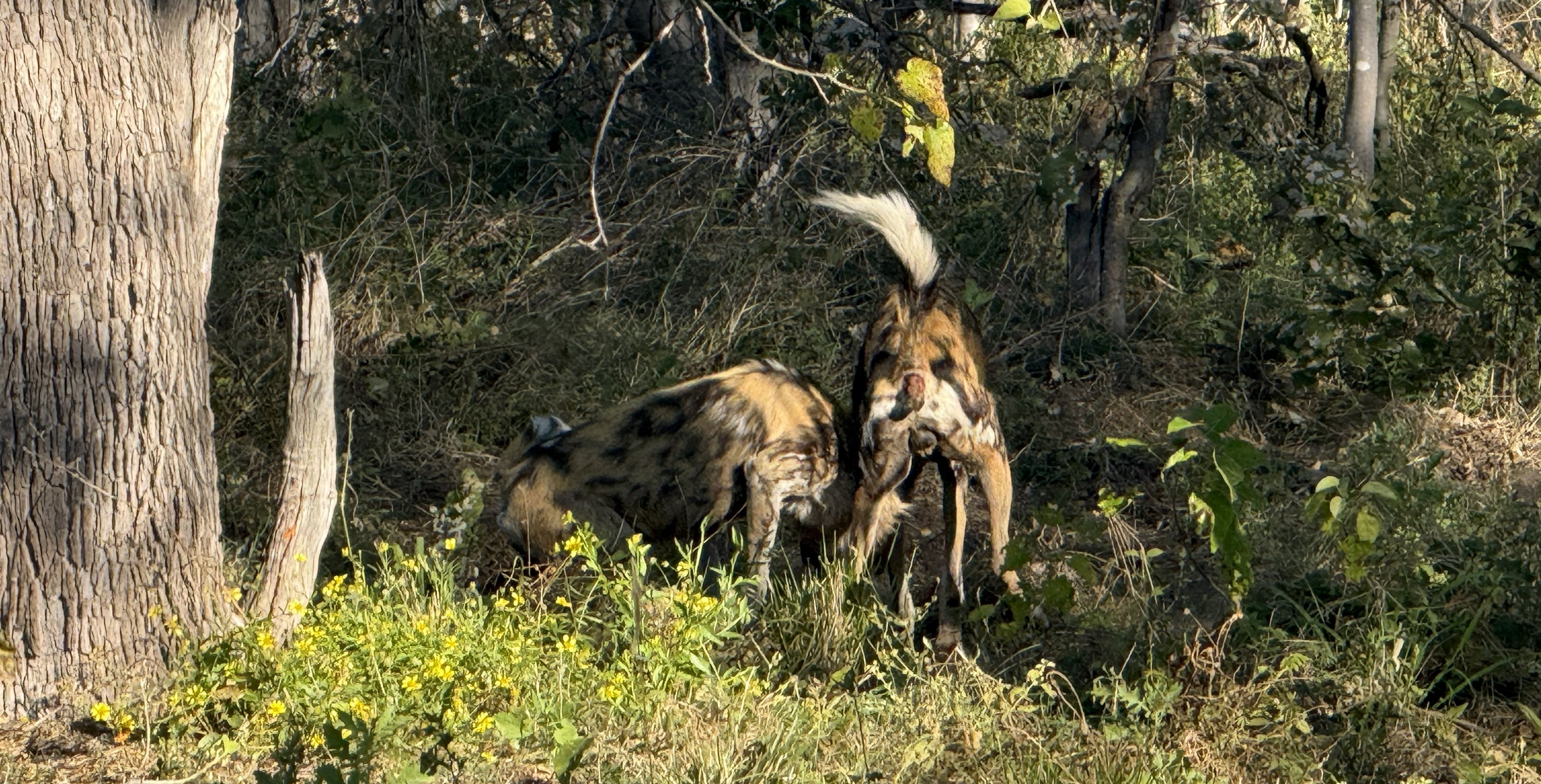
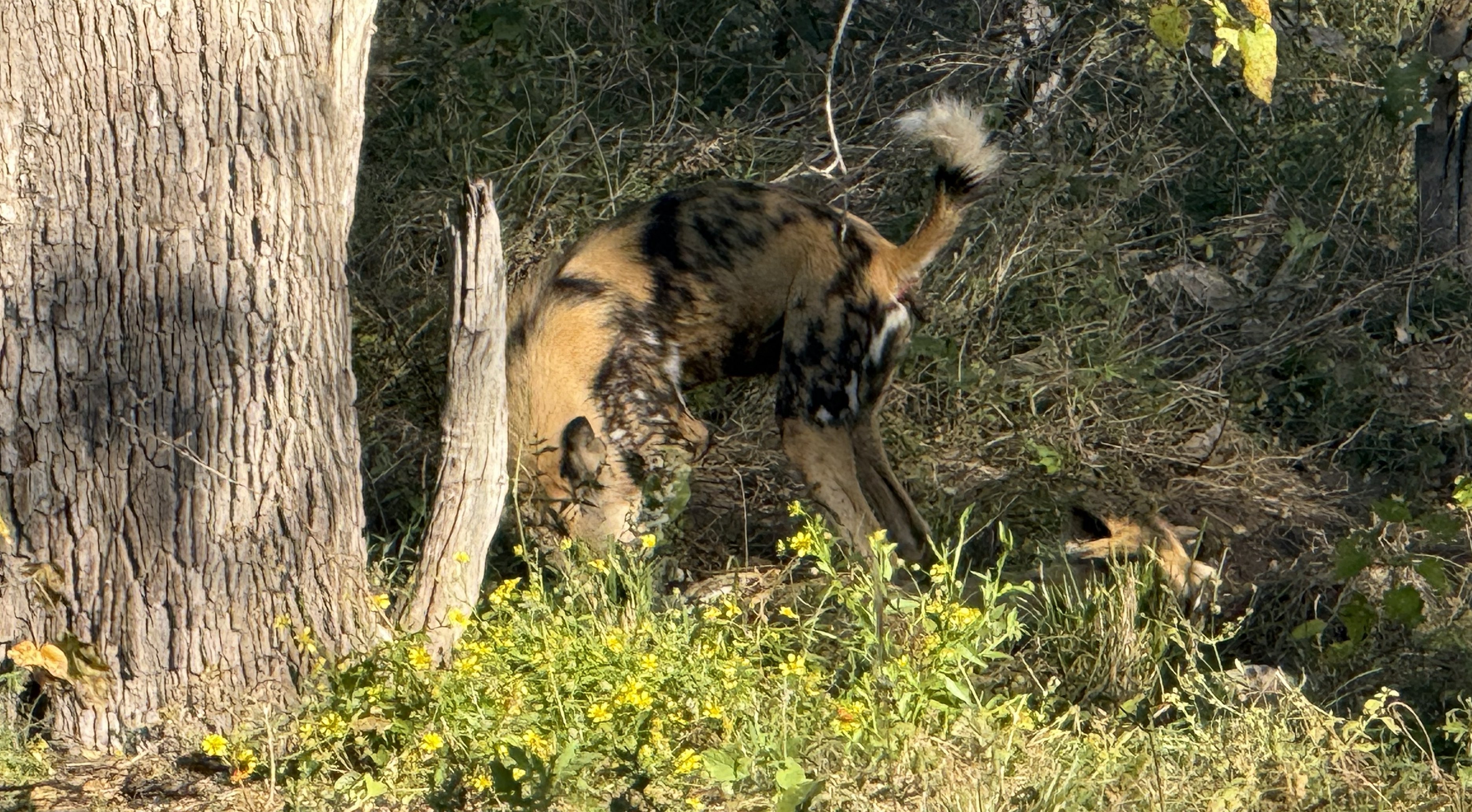
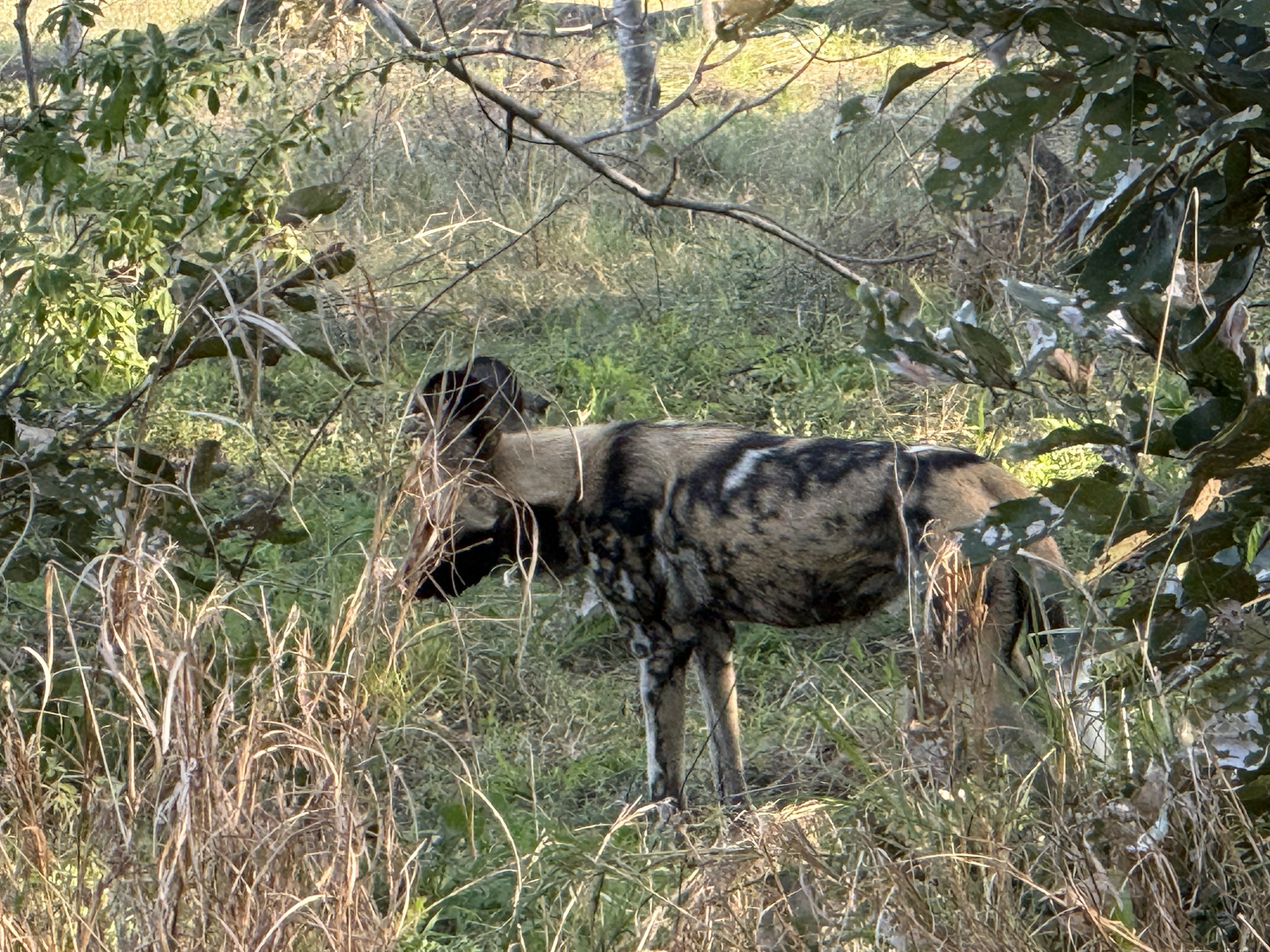
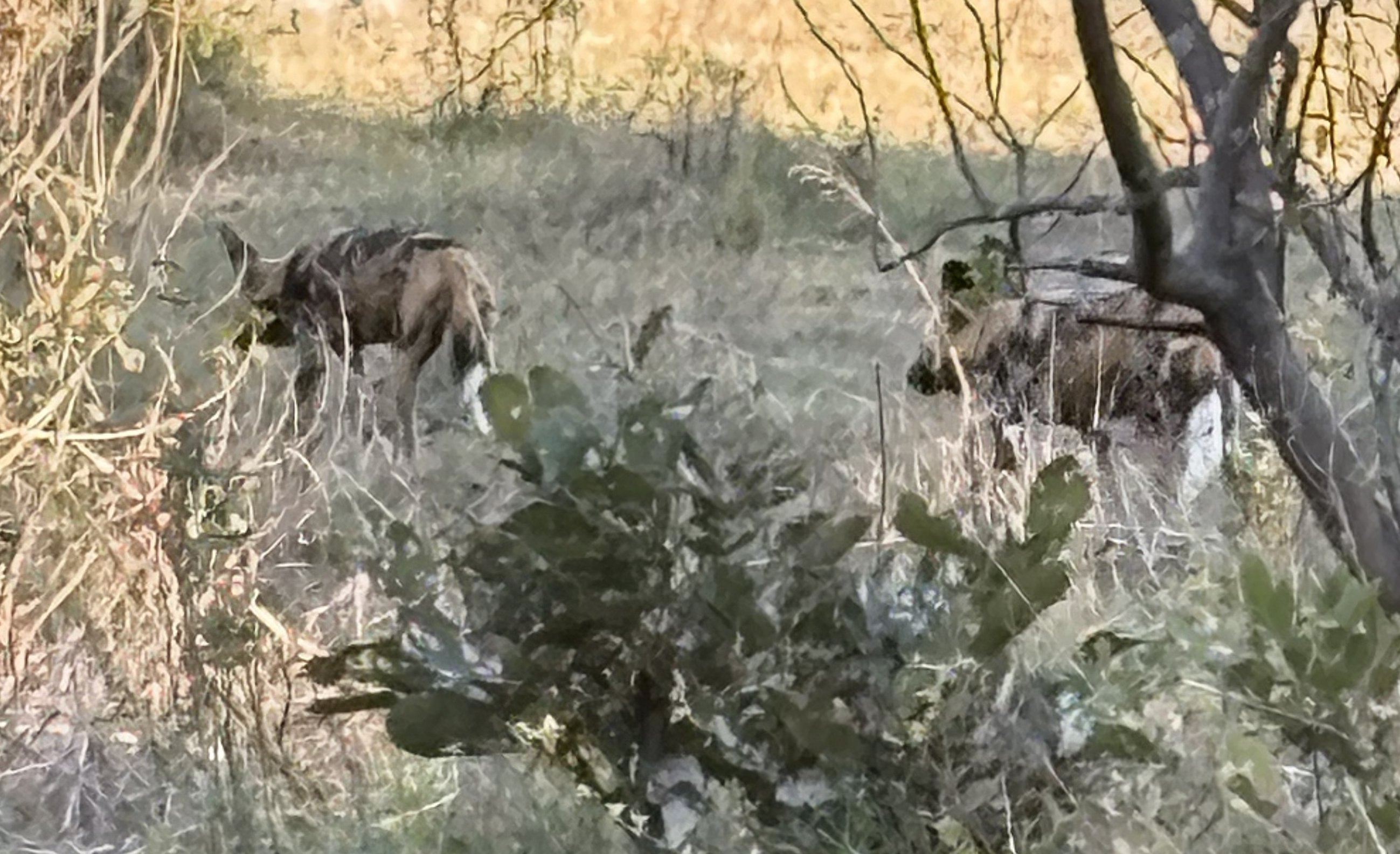
I will not pretend to be calm about this. We had not been out long when Obert took us off the track and in among the trees, and there — moving through the dappled shade with that unmistakable loose-limbed trot — was the pack. Painted dogs. Letlhalerwa. The animal I had been asking eleven days for, the second-most-endangered carnivore on the continent, fewer than six thousand left in all of Africa, and here were a dozen of them, close enough to hear.
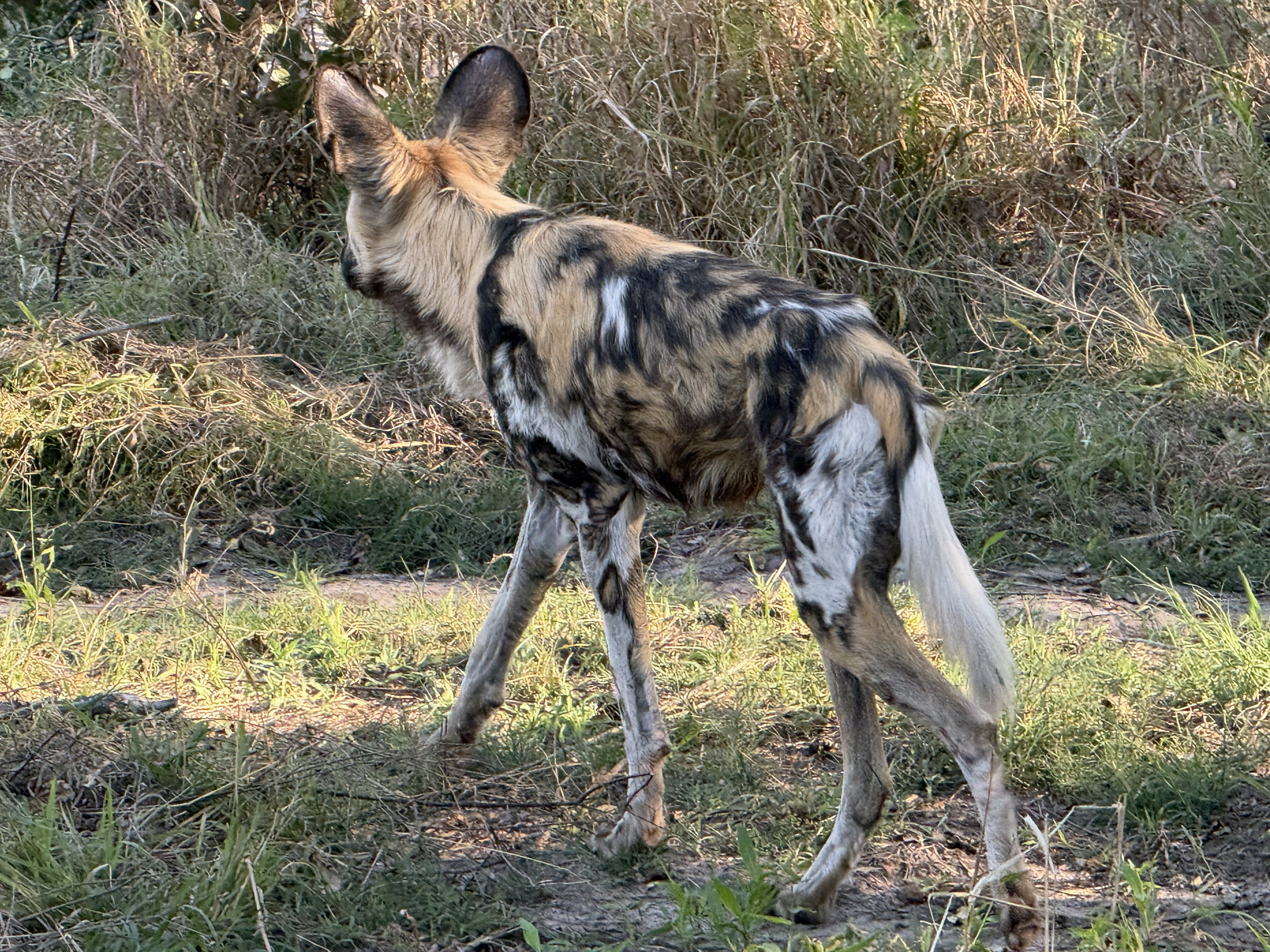
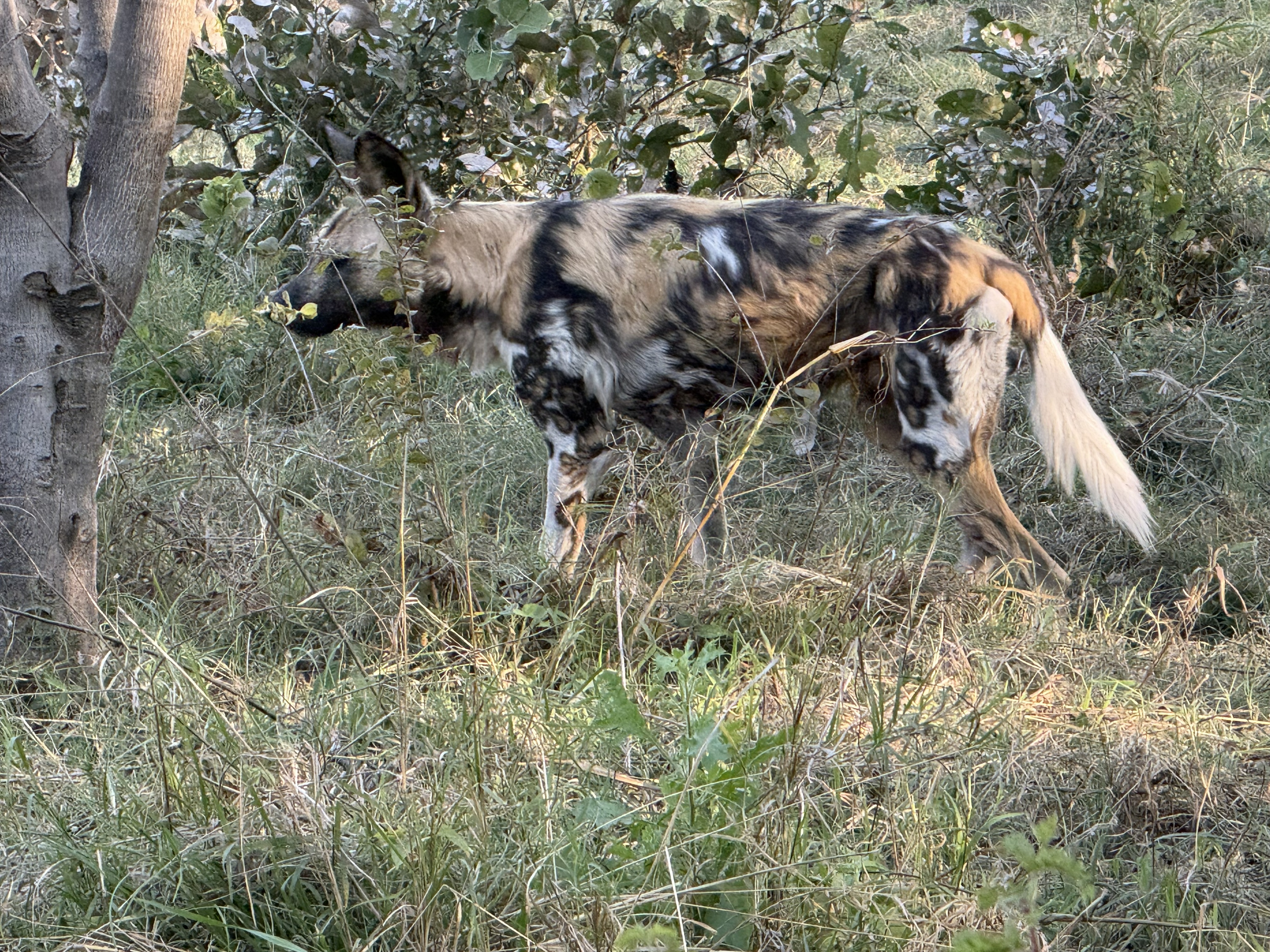
The first of them, through the trees. Every coat is different — a unique map of black, white, tan, and ochre — which is how researchers tell them apart, and why the old name, Lycaon pictus, means “painted wolf.”And then more, resolving out of the shade one by one, until the whole pack was in front of us.
The pack. Painted dogs live and hunt as a single social unit, and to see them all together — ears up, alert, entirely unbothered by the truck — is the sighting people plan whole trips around and mostly miss. We had been in the Delta for a matter of hours.One at the edge of the pack, giving us the big-eared, slightly cartoonish profile that makes them so instantly lovable and so easy to forget are among the most efficient predators alive.
Moving off through the grass — they are almost never still for long; a pack can cover astonishing ground in a day.Two of them, unhurried, in the last of the good light. I had asked, and asked, and asked, and the Delta had answered inside an afternoon. I could have gone home happy right then. I did not have to.
And the Delta's Ordinary Miracles
Because the same drive, almost as an afterthought, kept handing us the animals that would have made the whole day anywhere else.
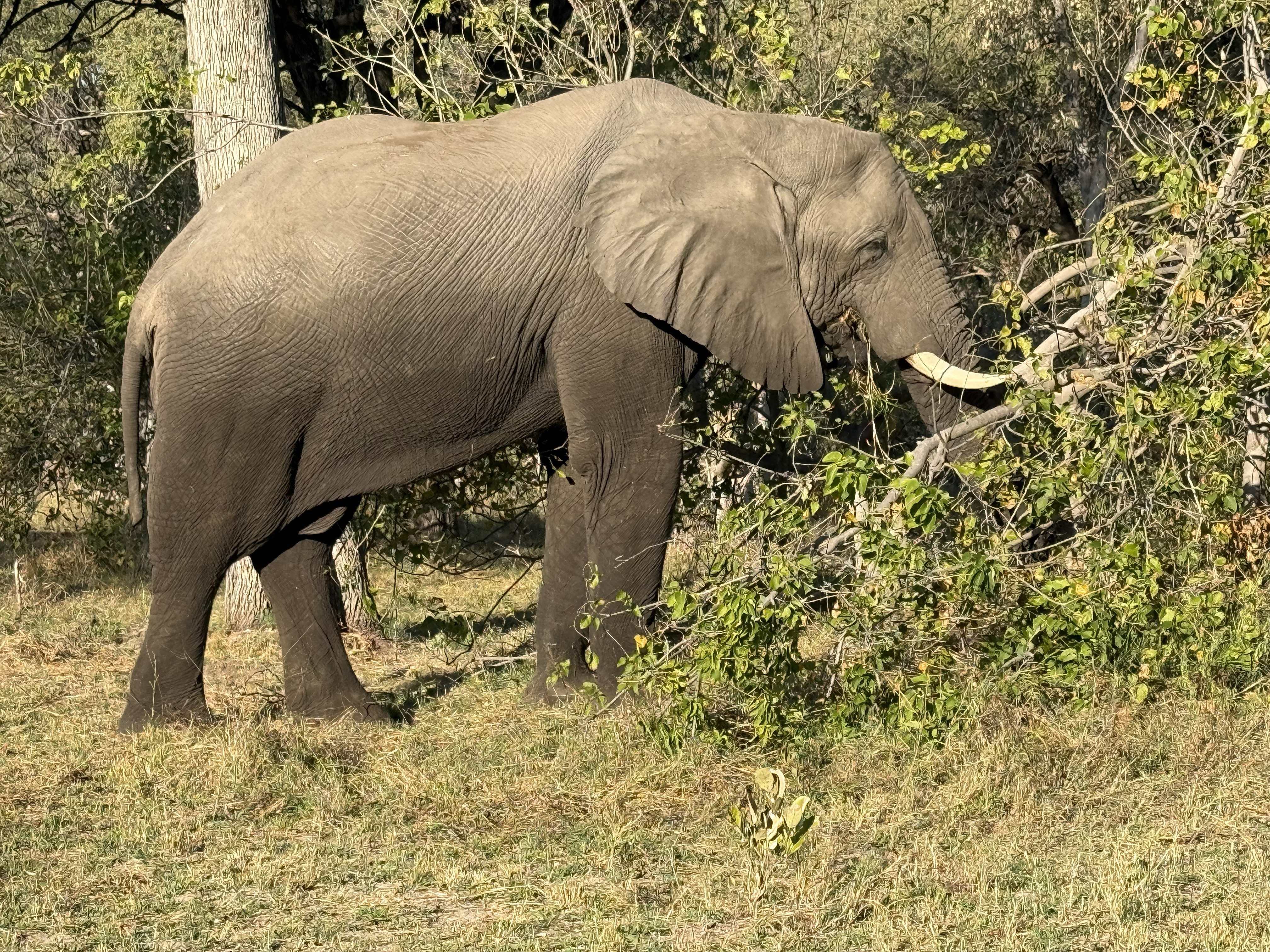
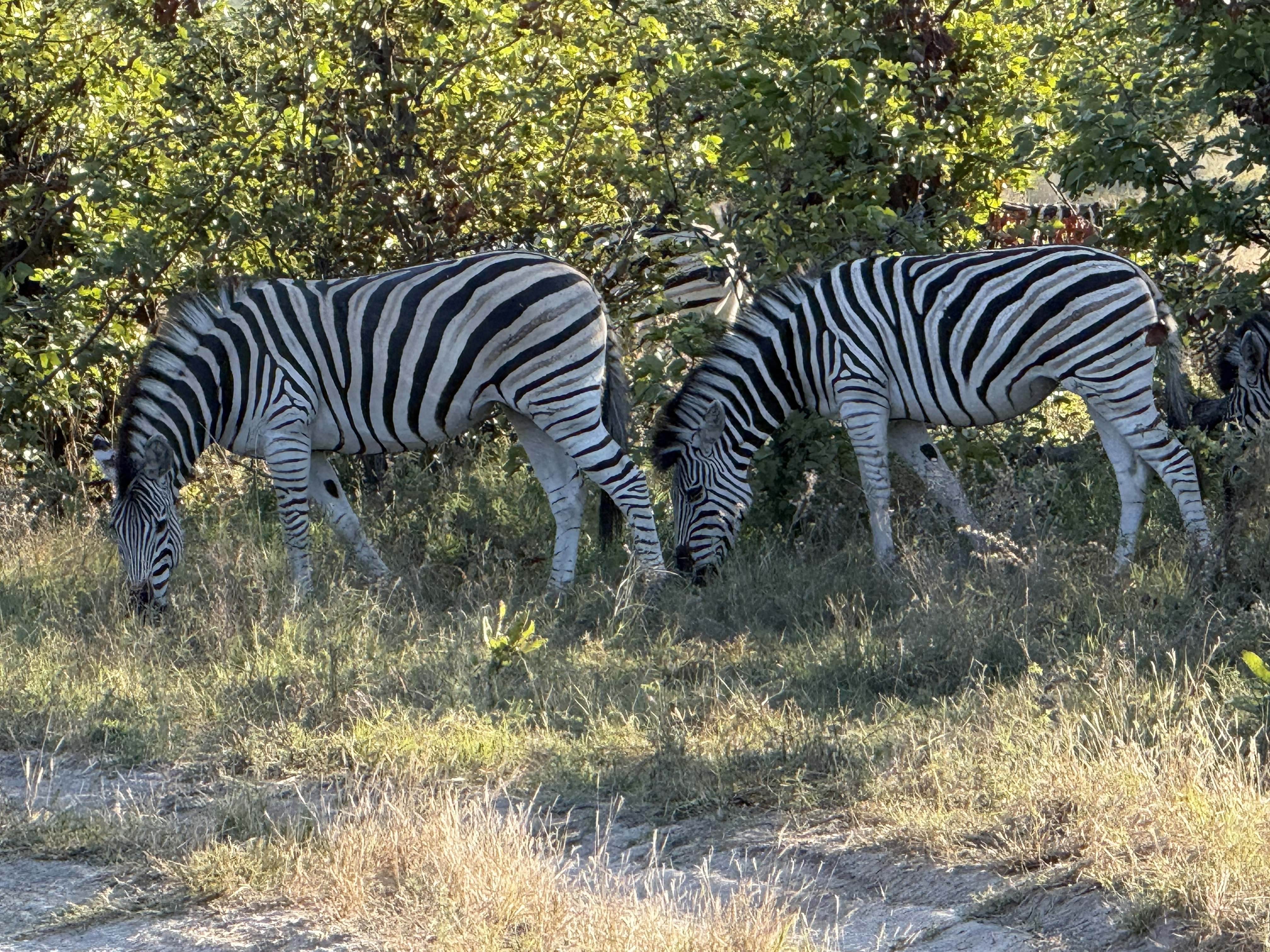
An elephant, browsing the green. Even the elephants feel different in the Delta — this is the country where they wade the channels and swim the deeper water, trunks up like snorkels.And a dazzle of zebra, which is the actual and entirely correct collective noun, and which no one should ever be asked to improve upon.
The Leopards
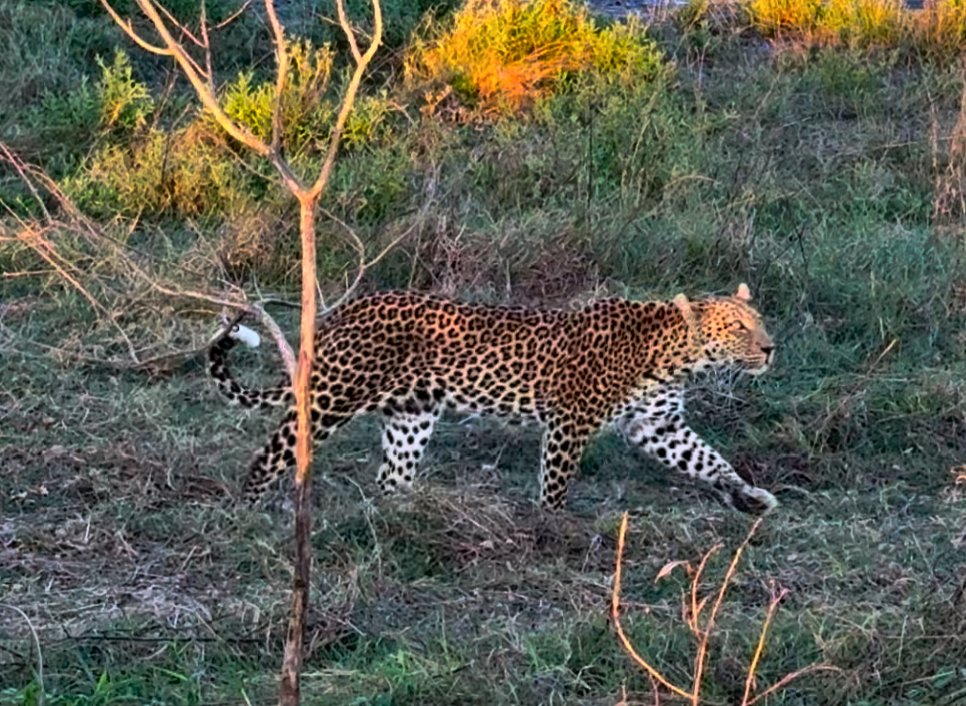
With the dogs answered, there was exactly one thing left on anybody's list, and the whole truck knew it. It is a peculiar feature of this business that you can have the thing you spent eleven days asking for, and within the hour be quietly wanting the next one. And then, as the light went gold, Obert stopped the truck, and said the word we had all stopped expecting to hear. There they were — not one leopard but two. A mother, sitting easy at the edge of the water in the last amber light, and her cub, all legs and energy, bouncing around her while she declined to be impressed. Both gaps closed inside a single afternoon — and the leopard, when it finally came, came doubled, and playing.
The first of them, walking out into the open. The leopard is the hardest of the big cats to see — solitary, nocturnal, a genius of not being found — and here was a mother strolling through the gold as though she had been booked for the occasion.
The cub, up on its feet behind her, tail curled into that big question mark — the whole time we watched, it could not hold still.And the mother, unbothered by any of it: that heavy-lidded, sovereign calm, the look of an animal that has never once had to hurry.
Mother and cub together at the water's edge, the pool behind them gone molten in the low sun. The cub kept springing about; she kept sitting. This is the photograph — eleven days of wanting, and it gave us not a fleeting glimpse but minutes, two leopards, close, in light like this.
Then, in their own time, off into the last of the light — gone as quietly as they had come.Sunset over the Delta, the first of our nights here. It had been, without any competition at all, the day.
For eleven days the tally at the bottom of every page had ended the same way: painted dogs, no; leopard, no. It had become a kind of running joke, and then a kind of quiet ache, and then just the shape of the trip. Today it ended differently, and I found I did not have anything clever to say about it. We had come across a continent and asked and asked; Dylan had turned the asking into an assignment; and the Okavango — on our first afternoon, before we had even unpacked — had handed us both. Tomorrow we would go looking at the water itself, in the low boats and the mokoro. Tonight there was nothing to want.